




Elisa Martins
Journalist, special for Yvirá
I am a high school chemistry teacher, and in 2024, we launched a project sparked by a question raised by the students: “What is the point of scientific practice in everyday life?”
We gathered the families for a meeting: we needed to reclaim our territory. One of the proposals was to reforest the area destroyed by the arson.
There is a lack of support and encouragement, and sometimes even a lack of funds for materials—which I occasionally pay out of my own pocket. But I believe in the transformative power of education.
Literacy in reading and writing goes together with mathematical literacy. We have also seen extensive dissemination and sharing of best practices with other teachers.
We move from persuasion to cross-sector collaboration; this isn’t just a bridge—it is the foundation. Schools need partnerships to carry out their initiatives.


Elisa Martins
Journalist, special for Yvirá
OCTOBER/NOVEMBER 2026 | n.º 9 | Winners of the 3rd Rede CpE Classroom Award explain how they reinvent themselves daily through projects that bring students and society closer together using science and social sustainability PHOTOS: PERSONAL ARCHIVE
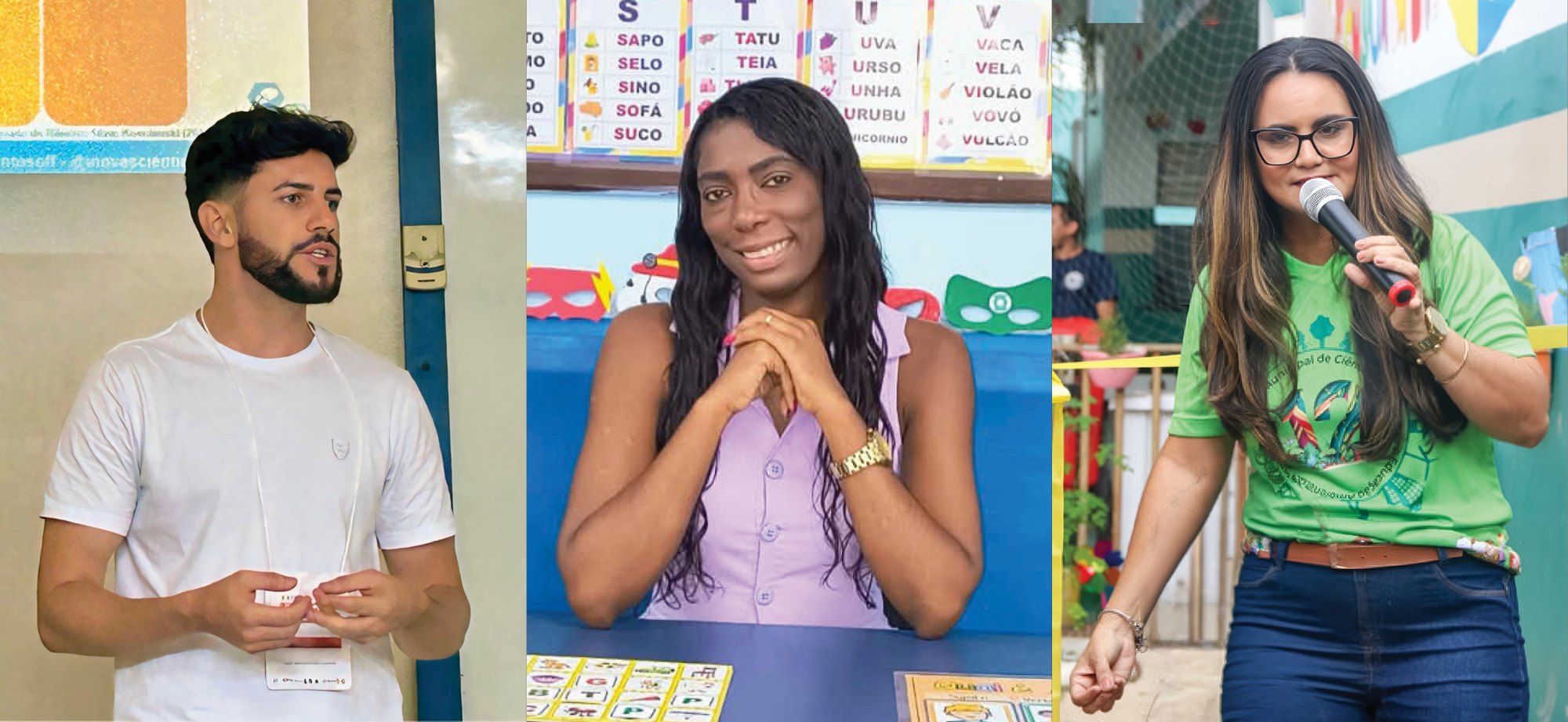
A literacy teacher from the Rio de Janeiro municipal school system, a specialist education teacher at a municipal daycare center in Manaus, and a high school teacher from a public school in Caraúbas, in the interior of Paraíba state. Three educators, three student profiles, three ways of teaching and learning. What they share are paths linked to social sustainability and science for education—journeys that led these three teachers to win this year’s 3rd Rede CpE Classroom Award.
Alef Santos (from the Serveliano de Farias Castro Integral Citizen School), Luziene Rosa (from the Maria Quitéria Municipal School), and Maria Raquel Souza dos Santos (from the Magdalena Arce Daou Municipal Daycare Center) talked with YVIRÁ about how they incorporate themes such as well-being, social and environmental justice, inclusion, and the reduction of social inequality into their pedagogical practice—using, of course, science-based education. By giving a voice to these initiatives, the Rede CpE and the UNESCO Chair—the organizations behind YVIRÁ—reinforce their commitment to bringing scientific output closer to society, connecting schools, scientists, and research institutions, and valuing experiences developed in the classroom. Read on.
 How did it feel to receive the news about the award? And how does the educational work you do relate to criteria for social sustainability?
ALEF SANTOS: When the results came out, I was shocked and happy. I knew we were competing against significant projects. I am a high school chemistry teacher, and in 2024, we launched a project sparked by a question raised by the students: “What is the point of scientific practice in everyday life?” That’s how the Sociobiodiversity and Living Cultures project began. The students reached out to family members and long-time residents of the Cariri region in Caraúbas, in the interior of Paraíba state. The idea was to understand what life was like in the past and the transformations the world—and that specific environment—were undergoing. Various themes and issues emerged from these narratives, which we then discussed in the classroom. The main issue was the desertification of the Caatinga biome and water scarcity. Residents were already suffering from a lack of water; they reported having to dig wells, walk long distances to find water in reservoirs and ponds, or wait for the rainy season. The students brought this information back, and we began to consider how traditional knowledge, combined with scientific content, could inspire us to minimize the impact of water scarcity. We looked at the house roofs, which were already being used for water harvesting but could be designed more efficiently. Given the shape of the gutter edges, a significant amount of water was lost upon contact with the roofing tiles. We studied the problem and developed a V-shaped roof design. The gutter was placed in the center of the roof to capture and channel the largest possible volume of water without altering the house’s structure. Tests showed a higher volume of collected water. We incorporated science, technology, engineering, art, and mathematics. We also discussed the best way to treat the collected rainwater. Previously, residents simply strained the water through a cloth or boiled it. The group then came up with the idea of connecting the runoff system to a low-cost filter that the residents themselves could maintain. It was a filter made up of layers of fabric, gravel, sand, activated charcoal, and cotton, designed to treat the water before it reached the storage tank. It represents an innovation—a form of social technology born from community knowledge—put into practice to help families in regions with low rainfall. Residents also visited the school and offered suggestions to improve the project. We continue working to make the runoff system increasingly efficient so that not a single drop of water goes to waste.
I am a high school chemistry teacher, and in 2024, we launched a project sparked by a question raised by the students: “What is the point of scientific practice in everyday life?”
LUZIENE ROSA: I was thrilled to receive the award. I presented the project Fun Literacy: Integrating Fantasy, Play, and Evidence in the Classroom. My students are children facing social vulnerability; they live in violent communities in Rio de Janeiro and generally struggle significantly with literacy. Their families often do not foster a literacy-rich environment at home and do not always grasp the importance of school. However, once the children are in the classroom, I move away from traditional, mechanical literacy instruction and step into their world of fantasy, using an alphabet filled with characters and heroes. To introduce the letter “B,” for example, I show a drawing of the letter, explain its sound, and ask the children for words they know. I explain that when “B” joins with “A,” it makes the sound “BA,” and then I ask what words they know or like that start with “BA.” Someone might choose “Batman.” Then we work through the alphabet based on what the children themselves say: “C” for Captain America, “D” for Doc McStuffins—which was once “Doctor Strange.” There’s the Flash, Puss in Boots, Spider-Man. I print out the names of the characters they mention and put them up on the wall as a visual aid. From there, we derive syllable groups. The children keep making suggestions and learning. We also have a “launch day” for the syllable group we’re studying, where we use accessories related to the chosen hero or character. I make masks and a Captain America shield. I even wear a costume—I become Batman. It might look like play, but it is deeply rooted in pedagogical intent. Everything is planned, using an approach that combines fun and excitement with learning. The level of attention changes, and attendance improves. Families get involved, too. Every week, I send something home for the child to read—sheets with a few written syllables, a small bag of words, texts, sentences, or a book. By the second semester, family members come to school to read to the whole class. At first, parents feel shy, but gradually they open up. Some even feel inspired to go back to school themselves, enrolling in the EJA (Youth and Adult Education) program at night. It’s a movement that starts at school and reaches the community.
MARIA RAQUEL: We knew our work was a collective effort—a true team endeavor—that held great potential and was worth the attempt. And, to our surprise and delight, we succeeded. Our project, From Burning Forest to Reforestation: Climate Change, Childhoods in the Periphery, and Proposals to Postpone the End of the World, was implemented at the Magdalena Arce Daou Municipal Daycare Center, where I work as a specialized education teacher supporting children with disabilities and specific needs. The center is in an outlying area of Manaus, right on the banks of a polluted stream that cuts across the entire city. During the mid-year dry season, someone broke into our facility and cut the power lines to steal copper; they entered through the riparian forest area and set a fire, causing a massive blaze. The fire not only devastated the vegetation but also caused serious respiratory issues for the children. We gathered the families for a meeting: we needed to reclaim our territory. One of the proposals was to reforest the area destroyed by the arson. We visited homes in the community and convinced families to join forces with us. We reached out to the municipal departments of Education, Environment, and Urban Sanitation. We secured seedlings, fertilizer, labor, and logistical support. We organized marches against urban burning and incorporated environmental themes into the classroom curriculum. By the time I entered the project for the award, we had planted 300 native tree seedlings. Today, there are over a thousand. The project continues to grow. We created an urban orchard that is already bearing fruit, which the children harvest themselves. We brought in Amazonian artists to explore art within a sustainability context using various media. We also produced a book in which one of our students—Rael, who is deaf—transforms into a defender of the forests and streams. We created a sensory garden where the trees engage our children’s senses. We organized community cleanup drives, removing over eight thousand PET bottles that had been discarded in the local stream. It was a truly beautiful initiative that led to further developments and tangible results.
We gathered the families for a meeting: we needed to reclaim our territory. One of the proposals was to reforest the area destroyed by the arson.
What is it like working with students who are growing up in a rapidly changing world, while ensuring the school remains an active part of the community and plays a meaningful role in society?
ALEF: I started in education in 2016, and since 2022, I’ve been working at a public school in the interior of Paraíba. My own questions and concerns mirror those of my students. I’m always asking myself how they can apply the knowledge we share, while simultaneously learning from their questions and seeking out new activities, technologies, and strategies that truly resonate. It is incredibly rewarding when we move beyond the abstract and bring science closer to the students’ actual lives. That’s where the focus on socio-biodiversity and living cultures came from. And it’s a project that keeps evolving. We’ll also be exploring the traditional cordel culture—which is part of my doctoral research—and discussing how to approach artificial intelligence not just to get answers, but to spark discussion and critically examine the information it provides.
LUZIENE: The school isn’t a separate entity; it’s part of these families’ lives. And that learning process can continue even after the children move up a grade or change schools. I keep in touch with former students who remain avid readers. They step away from their screens. The reading habit sticks and spreads to the whole family. I receive videos from mothers and fathers showing their children talking about the books they’re reading. It’s reading with genuine comprehension—and that’s what makes it all worthwhile.
MARIA RAQUEL: Children grow up, so many who were part of the project at the beginning—like Rael—have already left the daycare center. But new children soon arrive, with their own specific needs, and our work continues. The same goes for our ongoing partnerships with the families who join along the way. We have stepped beyond the institution’s walls and begun to truly engage in dialogue with the community. We are all part of the same process: education. It is an education that changes life paths and engages with all social stakeholders; it transcends physical boundaries and has a far greater impact than it would have if confined to the limited scope of a single classroom.
From the school’s perspective, it’s a solitary endeavor. Is there institutional support? How do you handle the challenges inherent in the Brazilian education system—often manifested as a lack of backing, encouragement, and training for teachers dealing with the day-to-day reality of the classroom?
ALEF: My family is my greatest inspiration in trying to overcome the adversities that arise. I come from a family of educators — my mother, aunts and uncles, and so on — but the pioneer was my grandfather. He lived in a rural area and began teaching his children to read and write before they even started school. Later, other residents who couldn’t read began coming to his home to learn as well. My grandfather taught classes on his porch, free of charge, and years later, he donated part of his own land so the local government could build a school. My mother attended that school, as I did, and it was named after an aunt who had passed away. When I think back on that journey and what my grandfather and family achieved through education, I simply can’t give up. There is a lack of support and encouragement, and sometimes even a lack of funds for materials—which I occasionally pay out of my own pocket. But I believe in the transformative power of education. I see the growth and the results of the learning process, and I believe it is possible to change reality.
There is a lack of support and encouragement, and sometimes even a lack of funds for materials—which I occasionally pay out of my own pocket. But I believe in the transformative power of education.
LUZIENE: I am privileged in that regard, as I have always had support at the school where I’ve worked since 2018. Before, I used to run literacy activities and create costumes for the children, but I kept to myself in my own little corner. It was the principal, Márcia Regina, who encouraged and convinced me to share the project with the other teachers, and later with the local government and the education department. We secured resources so the children could access tablets and other materials—such as paper and games—to work on mathematical concepts that can sometimes be very abstract. Literacy in reading and writing goes together with mathematical literacy. We have also seen extensive dissemination and sharing of best practices with other teachers. The more children who benefit, the better. Our literacy performance has been improving, and we are helping other schools by using a fun approach—one where the children are smiling—while learning alongside them.
Literacy in reading and writing goes together with mathematical literacy. We have also seen extensive dissemination and sharing of best practices with other teachers.
MARIA RAQUEL: For me, the biggest challenge is convincing people to act. When I bring issues to the group —to the other educators I work with — I must be persuasive. I need to explain what we should do, the impact it will have, and the improvements it can bring. That is why cross-sector partnerships are so important; they make a huge difference in education. On our own, we achieve very little, if anything at all. Schools often work in isolation, but they need to take that first step, reach out to other spaces, and seek partnerships. For our project, we also rely on help from universities. The Federal University of Amazonas provided support in agronomy and supplied fertilizer. The Federal Institute of Education, Science and Technology of Manaus—which already had a “Garden of the Senses” in its campus—helped us replicate that space at our school. We move from persuasion to cross-sector collaboration; this isn’t just a bridge—it is the foundation. Schools need partnerships to carry out their initiatives.
We move from persuasion to cross-sector collaboration; this isn’t just a bridge—it is the foundation. Schools need partnerships to carry out their initiatives.
Looking to the future, how can the Rede CpE award serve as inspiration to keep thinking about science and sustainability in education? How do you envision the continuation of your journey as an educator?
ALEF: We have support from the school’s local management — the coordinators and the principal— but we also need support at the state level. I hope this award helps open doors for us. I intend to keep developing the project with the students for as long as possible, helping it grow and showing them how education can offer better prospects for each of their futures.
LUZIENE: Receiving the Rede CpE award is not just an achievement; it is living proof that everything I have built—often quietly, through study, research, and facing classroom challenges—has meaning. It can break down walls, cross borders, and touch the hearts of so many other teachers and students involved in literacy education. I want to keep improving and sharing this project through lectures, training sessions, and consulting for public and private school systems. I want to show that it is possible to teach first-grade children to read and write by combining evidence and innovative practice with intentionality, playfulness, imagination, affection, and meaning. In the medium term, I plan to combine my practice with research by pursuing a master’s degree in education. I dream of expanding this work to reach even more teachers, especially those teaching literacy to first graders. I want to help them gain greater confidence, resources, and options for tackling the challenges of literacy education, while understanding that all children need opportunity, intentionality, and explicit instruction—because learning to read and write is not a biological process; it must be taught clearly and meaningfully.
MARIA RAQUEL: We hope the award amplifies our voice and brings greater visibility to a project that already impacts around 5,000 people in the region. May this serve as a source of energy, helping teachers feel valued and inspired to replicate this initiative in other settings. This is already happening; our sensory garden and reforestation efforts are already being replicated at other institutions. We hope this can become government policy—in daycares, schools, and urban spaces. From the state of Amazonas and the Northern region, we want to show that this is possible. And we want actions like these not to be confined to these specific locations, but to extend far beyond any boundaries. Our work cannot stop.