

What about?
Issues that concern teachers
OCTOBER/NOVEMBER 2026 | n.º 9 | In this section, experts invited by YVIRÁ answer questions submitted by teachers who are part of the National Science for Education Network (Rede CpE) as "Network Friends."
For this edition, we draw on the expertise of Rosa Maria Vicari, a professor at the Federal University of Rio Grande do Sul (UFRGS) and a leading authority on Artificial Intelligence applied to Education. She coordinates the UNESCO Chair on Information and Communication Technologies in Education, focusing on areas such as intelligent tutoring systems and educational agents. In the text below, the researcher discusses the use of AI in problem-solving and how it can impact students' imagination and creativity. She also notes that there are various ways to introduce AI into education. Read on to learn more.
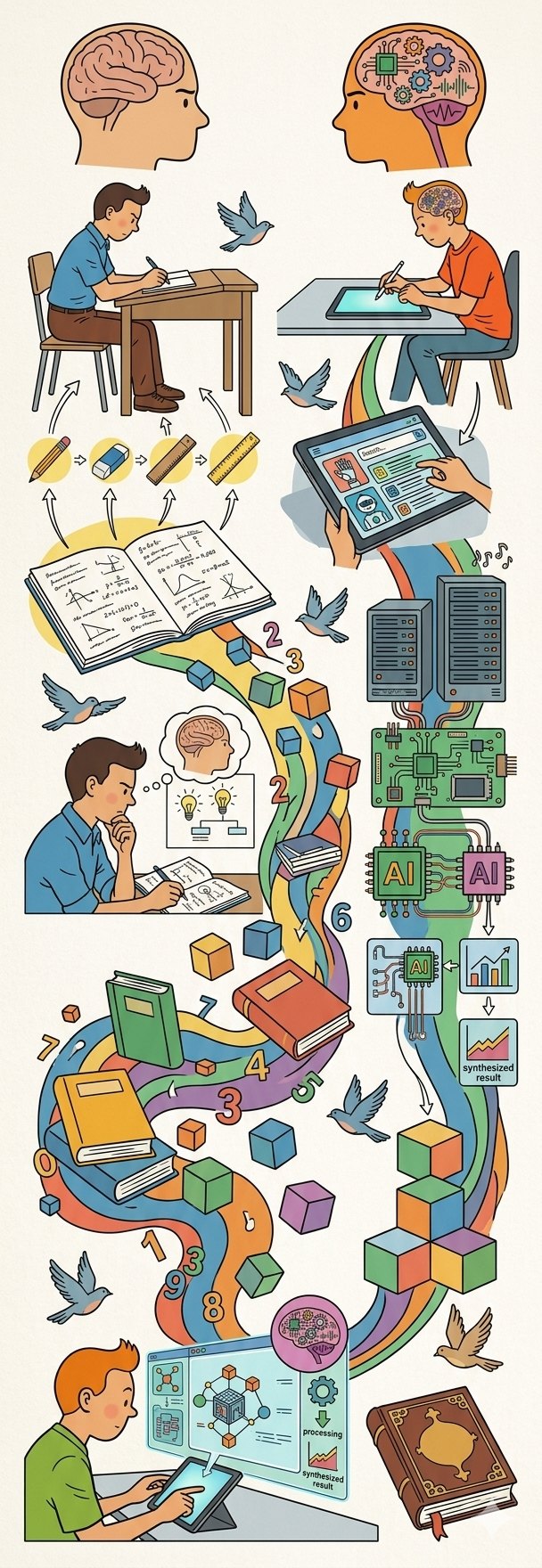
ILLUSTRATION: C. FLEURY WITH GEMINI
AI in education
"Which are the risks of relying on AI to solve educational problems, and how might this affect the development of students' ability to handle complex cognitive challenges?"
Submitted by Virgínia Baptista Chaves Duarte de Lima, educator/founder of Glia Neurociência Educacional, neuroscientist, and K-12 teacher (Rio de Janeiro, RJ)
Rosa Maria Vicari
Professor at the Institute of Informatics, Federal University of Rio Grande do Sul (UFRGS)
Personally, I believe that using AI for problem-solving—whether the problems are complex or not—impacts students’ imagination and creativity, as these are two dimensions that AI does not possess.
The approach our research group advocates is AI literacy—encompassing data, algorithm, and model literacy, as proposed by UNESCO in 2022.
Rosa Maria Vicari
Professor at the Institute of Informatics, Federal University of Rio Grande do Sul (UFRGS)
Many countries and schools choose to use artificial intelligence solely to support learning across various subjects (for example, Estonia and Ecuador).
In my opinion, this is not the only path, and perhaps not the best one. AI can assist with suggestions, concept maps, reading recommendations, and more during stages involving problem-solving. It can also simply provide a solution for students. Students who already had access to technology—such as electronic devices, the internet, and search engines—were already using it to aid in problem-solving even before the advent of AI. AI has merely increased the use of technology. However, it is still too early to say whether it affects students’ ability to handle cognitive challenges.
Some studies, conducted primarily in the US, indicate that students who use AI in various ways to solve problems activate different areas of the brain compared to students who do not use technology. For instance, a 2025 study by the Massachusetts Institute of Technology (MIT) involving 54 students who used ChatGPT to write texts showed that this usage activated distinct brain areas compared to students who did not use AI. Reports from the 2026 Program for International Student Assessment (PISA 2025) highlight the improved performance of students from Macau (China), who achieved the best global results in problem-solving. Educational authorities at the island attributed this strong performance to the students’ regular use of technology.
Personally, I believe that using AI for problem-solving—whether the problems are complex or not—impacts students’ imagination and creativity, as these are two dimensions that AI does not possess. Therefore, AI serves neither to replace nor to stimulate these dimensions in students. AI provides answers based on predictive knowledge (factual knowledge). Aware of these limitations, the teacher can challenge students to develop these dimensions themselves.
Personally, I believe that using AI for problem-solving—whether the problems are complex or not—impacts students’ imagination and creativity, as these are two dimensions that AI does not possess.
There are, however, various ways to introduce AI into education. The approach our research group advocates is AI literacy—encompassing data, algorithm, and model literacy, as proposed by UNESCO in 2022. Furthermore, we advocate for “thinking with AI” (using AI to solve problems) and “thinking about AI” (understanding how AI solves those problems). The better students understand how AI operates, the more aware they become of the technology’s limitations and potential. This understanding fosters more conscious usage. Another factor that cultivates critical use among students is awareness regarding the resources consumed by AI (such as water, energy, and critical minerals) and the user’s responsibility regarding its use.
The approach our research group advocates is AI literacy—encompassing data, algorithm, and model literacy, as proposed by UNESCO in 2022.