Mônica Oliveira Researcher at the Center of Science for the Development of Basic Education: Learning and School Coexistence (CCDEB/Institute of Psychology USP) Post-doctoral fellow FAPESP – Interinstitutional Laboratory for Studies and Research in School Psychology (LIEPPE) – Institute of Psychology, USP Founder of the Nature Connection Institute Friend of the CpE Network
Virgínia Chaves Educator and PhD. PhD in Neuroscience from UFRJ Founder of Glia Educational Neuroscience Friend of the CpE Network
When we talk about playing with and in Nature, we are not just talking about a pleasant experience for childhood.
In childhood, the nervous system is still undergoing intense development and responds particularly sensitively to the quality of experiences offered by the environment.
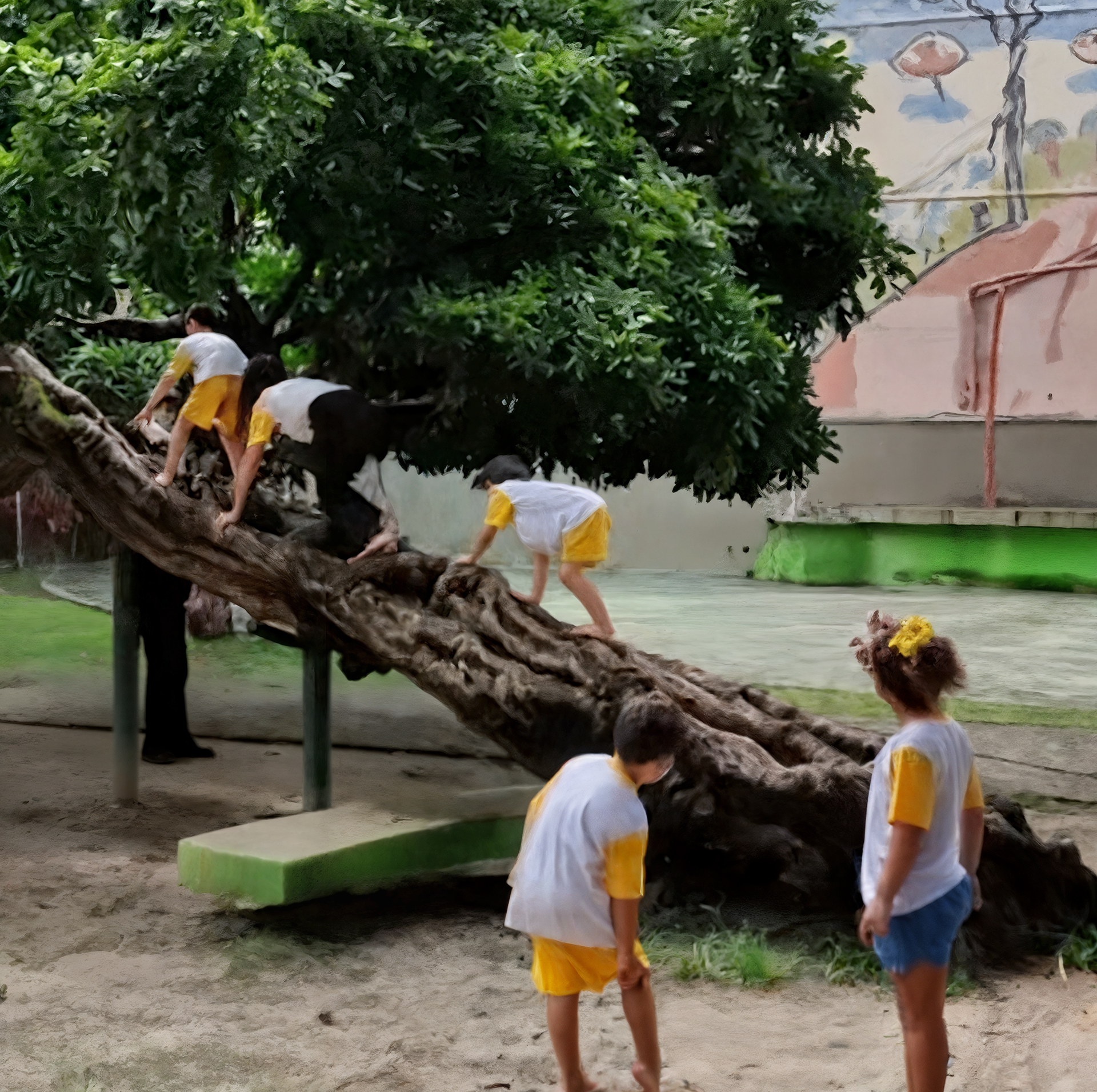
In several accounts, the idea emerged that the school grounds can accommodate a patio rich in nature, vegetable gardens, and flower gardens.
The process of breaking free from confinement doesn’t begin in the playground. It begins when the pedagogical perspective starts to see it as a legitimate field for development and learning.
Mônica Oliveira Researcher at the Center of Science for the Development of Basic Education: Learning and School Coexistence (CCDEB/Institute of Psychology USP) Post-doctoral fellow FAPESP – Interinstitutional Laboratory for Studies and Research in School Psychology (LIEPPE) – Institute of Psychology, USP Founder of the Nature Connection Institute Friend of the CpE Network
Virgínia Chaves Educator and PhD. PhD in Neuroscience from UFRJ Founder of Glia Educational Neuroscience Friend of the CpE Network
JUNE/JULY 2026 | n.º 7 | Playing is one of the experiences that most mobilizes the foundations of child development and should not be merely considered ‘leftovers from the routine’ by caregivers and schools
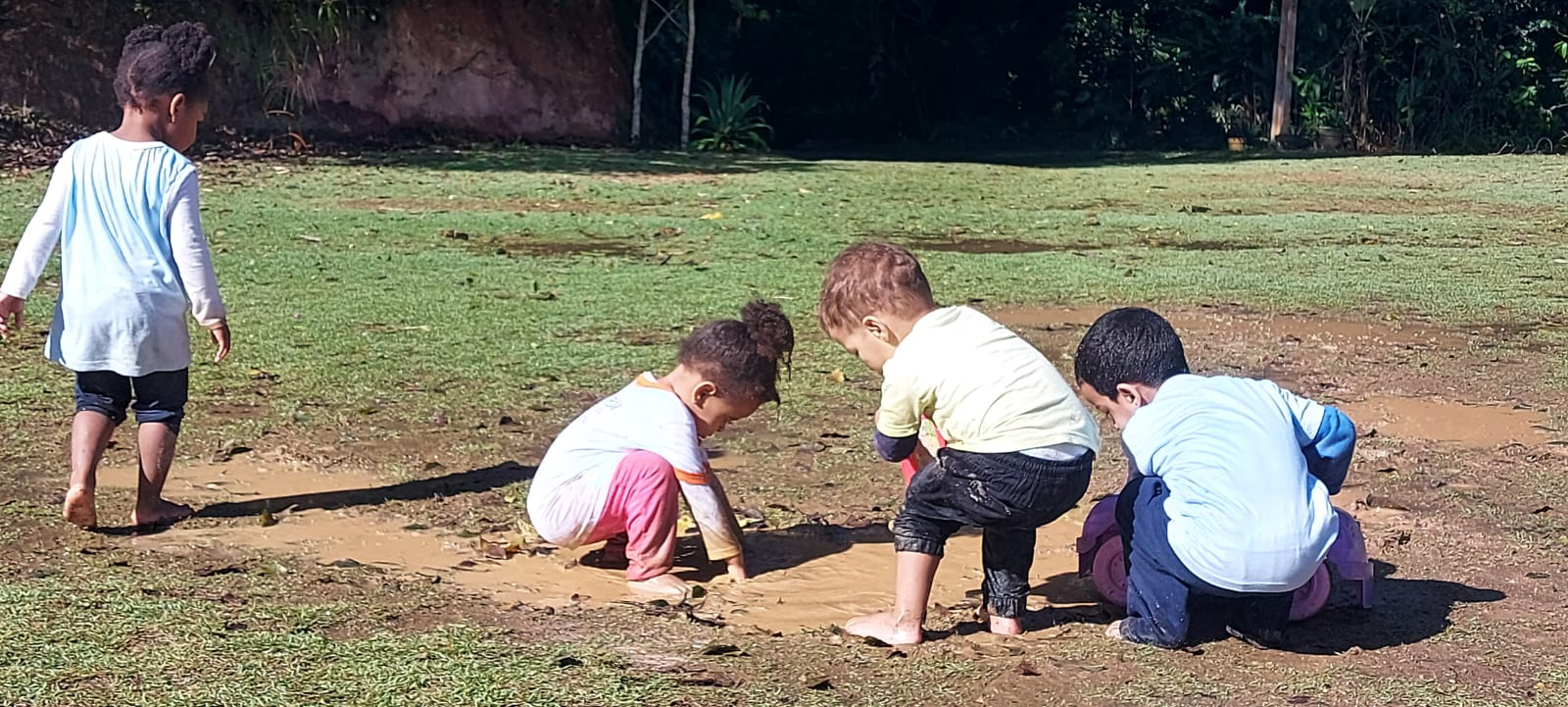
In daycare centers and preschools, many children spend up to 10 hours a day indoors. They spend less time in the sun, outdoors, in contact with the earth, with water, and with play that engages the whole body. This confinement is not just a characteristic of school infrastructure. It alters the quality of the child’s experience and impoverishes the field of experience through which the child explores, imagines, perceives limits, negotiates with others, and learns about the world.
In a time marked by excessive screen time and a deficit of Nature (written here with a capital letter by choice of the researchers, who recognize Nature as a subject of rights), this loss takes on a different weight. Outdoor play ceases to be a detail of the routine and becomes an important piece in understanding how the child regulates attention, organizes behavior, and learns in relation to the environment and others. Recent reviews suggest that these experiences are associated with gains, albeit modest, in attention, executive functions, engagement, and well-being. It is at this point that Nature, development, and school cease to be separate themes.
When we talk about playing with and in Nature, we are not just talking about a pleasant experience for childhood. We are talking about situations in which the child needs to uphold rules, remember agreements, control impulses, adapt to the environment, and adjust their own behavior in the face of the unexpected. This set of skills integrates the so-called executive functions, especially inhibitory control, working memory, and cognitive flexibility, described by Adele Diamond, a researcher at the University of British Columbia, as central to self-regulation, attention, and learning.
When we talk about playing with and in Nature, we are not just talking about a pleasant experience for childhood.
This matters to school because executive functions are not peripheral skills. They help the child to wait, focus, deal with frustration, manage aggression, change strategies, follow rules, solve problems, and practice empathy. In other words, they help to cognitively and emotionally organize the school experience.
What Neuroscience Helps Us Understand
Neuroscience helps explain why this experience is so powerful. In childhood, the nervous system is still undergoing intense development and responds particularly sensitively to the quality of experiences offered by the environment. In their studies, American psychologist Michael Posner and his collaborators show that attention and self-regulation depend on neural networks that mature throughout childhood and are also shaped by experience. Outdoor spaces with natural elements often bring together sensory variety, extensive movement, active exploration, gradual challenges, and a constant need for adaptation. This becomes clearer when we observe how these situations mobilize specific executive functions. Inhibitory control is called upon when the child needs to wait, contain impulses, assess risks, or negotiate rules during play. Working memory comes into play when the child keeps in mind agreements, routes, objectives, and sequences of action. And cognitive flexibility appears when it is necessary to change strategy, transform materials into new uses, or find solutions to unforeseen events.
In childhood, the nervous system is still undergoing intense development and responds particularly sensitively to the quality of experiences offered by the environment.
In a study with preschool children, American researcher Andrew Koepp and colleagues found a higher level of attention after outdoor play than after indoor play. Researchers Lan Nguyen and Jared Walters also suggest positive, albeit small and heterogeneous, effects of exposure to nature on children’s cognition, especially on attention and executive functions.
What the field reveals
Data from a recent survey we conducted at the Oswaldo Cruz Institute helps to bring this discussion into practice. In the virtual-experiential training conducted with Early Childhood Education professionals in the state of Rio de Janeiro, we received 354 applications, selected 103 participants, and had a 70% completion rate. Among the results, 64% of the professionals reported spending 8 to 10 hours a day at the daycare, and 88% reported that the children play outdoors for two hours or less per day.
On the other hand, 100% agreed that playing outdoors is fundamental for child development. Therefore, there is a clear mismatch between what educators recognize as important and what daily life offers.
Throughout the course, the participants’ records showed that when continuing education introduces this topic in a qualified manner, the educators’ perspective begins to change, and with it, the way the school organizes its outdoor space also changes. The educators reported transformations in their daily lives with the children, a review of routines, and greater attention to the possibilities of offering experiences in the surroundings of the daycare and preschool, benefiting more than 2,500 children.
In several accounts, the idea emerged that the school grounds can accommodate a patio rich in nature, vegetable gardens, and flower gardens. This image accurately reflects the central shift of the research: it is not just about opening the classroom door, but about relearning to see the outside as part of the pedagogical work and not as a residual space of the routine.
In several accounts, the idea emerged that the school grounds can accommodate a patio rich in nature, vegetable gardens, and flower gardens.
The educators also reported the perception of “bodies that cannot balance, perceive themselves in spaces, have a sense of strength and momentum, racing minds, restlessness, lack of concentration.” This observation should not be taken as causal proof, but it deserves to be listened to seriously. It suggests that context matters more than we often admit.
If playing with and in Nature contributes to the development of executive functions important for school life, then it cannot continue to be treated as a one-off event or as an afterthought in the routine. But this change doesn’t depend solely on physical space. It gains consistency when teachers are supported by recognizing the pedagogical value of the outdoors, planning experiences in this context, and observing children in less controlled situations. The process of breaking free from confinement doesn’t begin in the playground. It begins when the pedagogical perspective starts to see it as a legitimate field for development and learning.
The process of breaking free from confinement doesn’t begin in the playground. It begins when the pedagogical perspective starts to see it as a legitimate field for development and learning.
When educators begin to look at the possibilities of the surroundings and discuss how the school grounds can accommodate vegetable gardens, flower gardens, and a playground rich in Nature, what shifts is not only the organization of space, but the very way of understanding childhood. This is why continuing education takes center stage: it not only informs, but expands repertoire, legitimizes pedagogical choices, and strengthens the teacher as a mediator in this process.
It is in the daily actions of teachers, when supported by knowledge, intentionality, and ongoing training, that the outdoors can cease to be an intermission and truly become an integral part of Early Childhood Education. For this reason, we created the “Play Connection” course. Let’s go outside and play with our children!
 ARTICLE