A podcast for children who sniff out science in everything
Fernando Louzada Neuroscientist and professor at the Federal University of Paraná Member of the CpE Network and of the Editorial Committee of Yvirá
The episodes follow a similar structure: presenters Alexandra Equey and Laura Chaloub dialogue, contextualize and comment on the statements of a guest researcher.
In addition, the episodes show a welcome attention to environmental issues, with discussions about climate change and endangered species.
It is possible to address serious and relevant topics, connected to the current moment, sparking reflections that cross all age groups.
Fernando Louzada Neuroscientist and professor at the Federal University of Paraná Member of the CpE Network and of the Editorial Committee of Yvirá
JUNE/JULY 2026 | n.º 7 | Launched by the Instituto Ciência Hoje, ‘Nariz de Tamanduá’ shows how the digital world can integrate the classroom to promote learning
IMAGES FROM INSTAGRAM @NARIZDETAMANDUA
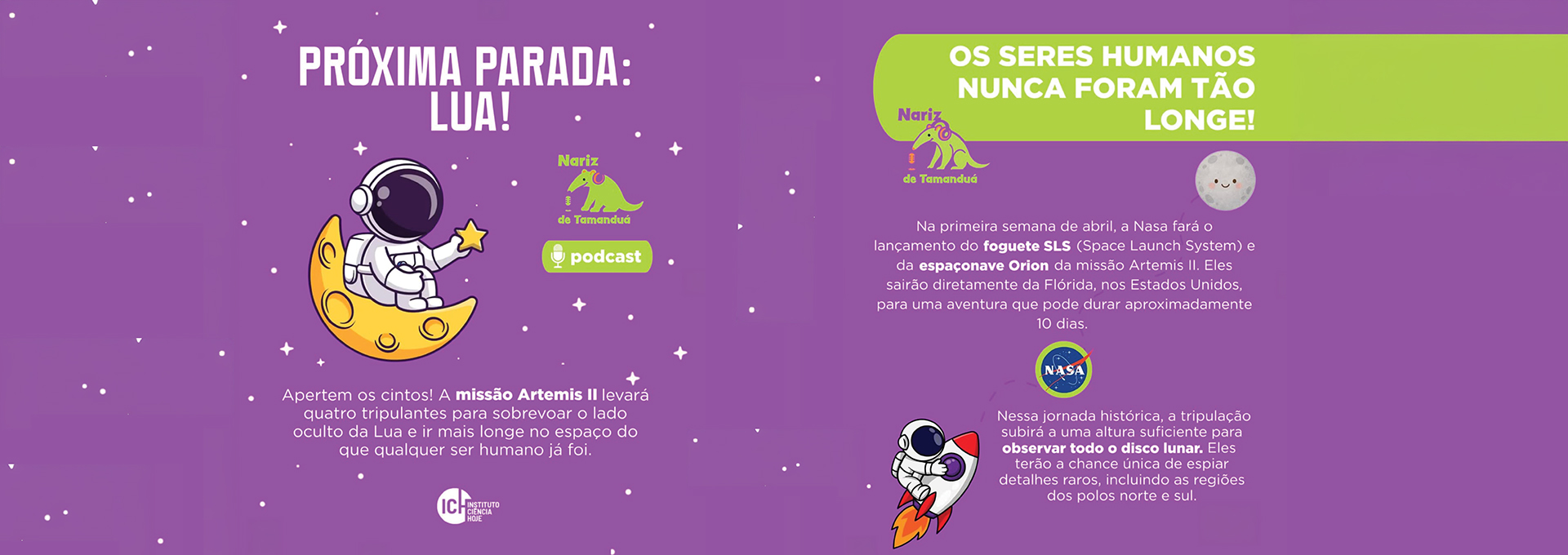
Brazil has been producing excellent science podcasts for some time now — mostly for adults but also aimed at children. This doesn’t stop us from celebrating the arrival of another excellent children’s production, especially when it bears the seal of the Instituto Ciência Hoje, responsible for the Ciência Hoje das Crianças magazine for decades. This is the case with Nariz de Tamanduá (“Anteater´s Nose”), available on major digital platforms and which, at the time of this publication, is in its first season, with episodes whose themes reflect the breadth of the proposal: Sleep of Animals, The Moon, Whales and Turtles, Smell, Coral Reefs and Our African Roots.
The episodes follow a similar structure: presenters Alexandra Equey and Laura Chaloub dialogue, contextualize and comment on the statements of a guest researcher. In addition to the successful effort to adopt accessible language, they also take care to explain terms that arise during the conversation and may sound like “Greek” to children, such as “gas chromatography,” a technique used to identify components of a mixture. After the first two episodes, which featured male interviewees, there was concern that the podcast might reinforce the idea that science is predominantly male. Fortunately, subsequent episodes featured female researchers as guests, restoring an important balance.
The episodes follow a similar structure: presenters Alexandra Equey and Laura Chaloub dialogue, contextualize and comment on the statements of a guest researcher.
After the first two episodes, with male interviewees, there was concern that the podcast could reinforce the idea that science is predominantly male. Fortunately, the following episodes brought female researchers as guests, restoring an important balance.
Certainly, children and adults will be interested in hearing curiosities about animal sleep, the dark side of the Moon – especially with NASA’s recent Artemis Mission – the reproduction of whales and turtles, the universe of smells, the importance of preserving coral reefs, and the rich legacy of African culture. In addition, the episodes show a welcome attention to environmental issues, with discussions about climate change and endangered species.
Alexandra and Laura show that talking about science to children goes far beyond listing curious facts. It is possible to address serious and relevant topics, connected to the current moment, sparking reflections that cross all age groups.
In addition, the episodes show a welcome attention to environmental issues, with discussions about climate change and endangered species.
It is possible to address serious and relevant topics, connected to the current moment, sparking reflections that cross all age groups.
Inevitably, due to the short duration of the episodes — about 15 to 20 minutes — we missed topics that could be explored in more depth. In the first episode, about sleep, the researcher associates its function with energy conservation, leaving aside other already demonstrated roles linked to the immune system and cognition. Perhaps these choices are due to the need for brevity, but the listener may conclude that sleep deprivation is limited to tiredness, when we know that it brings several consequences for health and cognitive performance. Perhaps this choice for brevity can serve as a starting point for developments in future seasons.
“Nariz de Tamanduá” shows how the digital world can integrate the classroom to promote learning. Many activities can arise from listening to the podcast — especially when done collaboratively between children and families, with the mediation of teachers, further expanding the possibilities for exchange and construction of knowledge.