Building blocks to activate computational thinking
Raimundo da Silva Soares Junior Neuroscientist and Postdoctoral Researcher in Neuroscience at the D’Or Institute for Research and Education (IDOR)
João Ricardo Sato Neuroscientist and Full Professor at the Federal University of ABC
Introducing these concepts in early childhood education and the early years of elementary school presents a significant pedagogical challenge. At this stage, children are still acquiring literacy skills and rely heavily on concrete reasoning.
Spatial reasoning helps the child understand relationships involving shape, size, position, distance, and orientation. We use this type of reasoning, for example, to visualize how to rotate and position a piece until it fits into a puzzle.
These integrated experiences are crucial because they allow students to transition from physical manipulation to abstract logical reasoning, solidifying the foundations of creativity and problem-solving that will underpin their overall development.
Raimundo da Silva Soares Junior Neuroscientist and Postdoctoral Researcher in Neuroscience at the D’Or Institute for Research and Education (IDOR)
João Ricardo Sato Neuroscientist and Full Professor at the Federal University of ABC
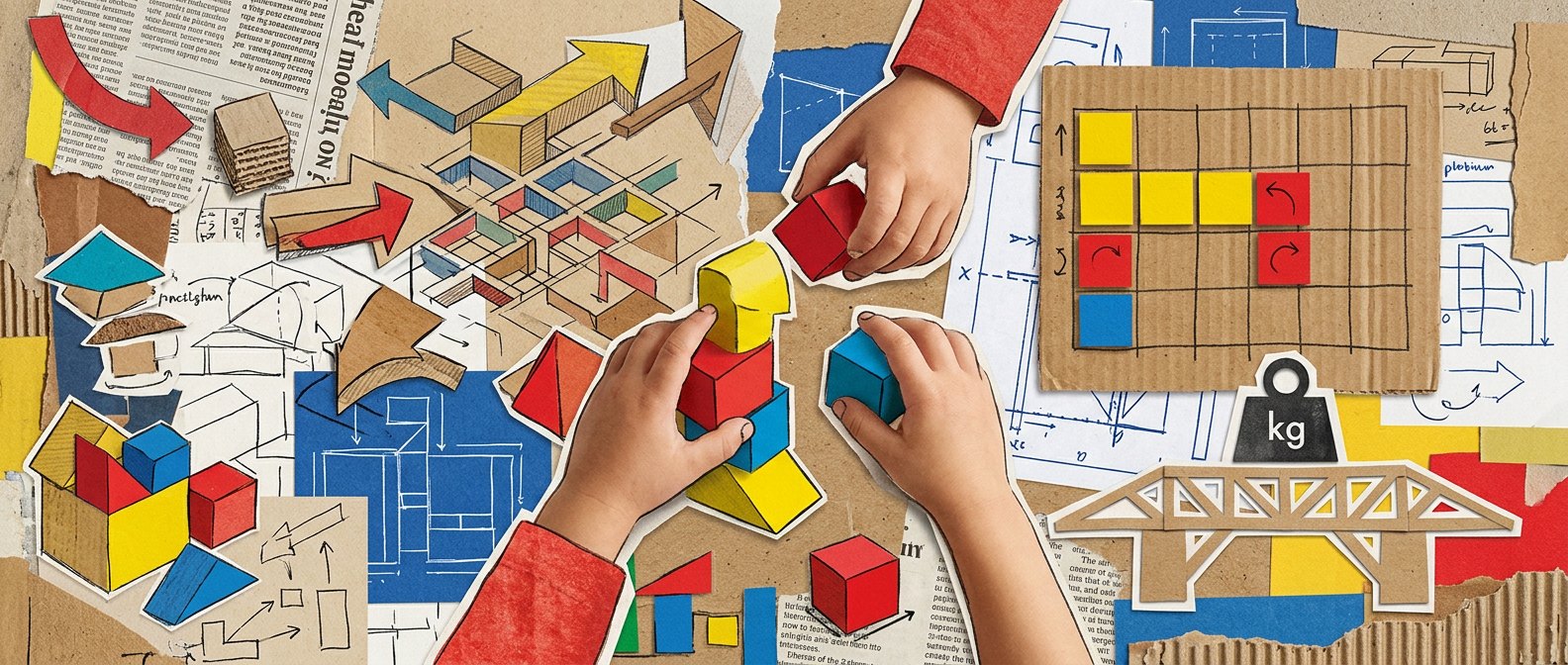
OCTOBER/NOVEMBER 2026 | n.º 9 | A proposed pedagogical model featuring hands-on activities highlights how manipulating concrete pieces helps children structure complex mental representations
ILLUSTRATION: C. FLEURY WITH FIREFLY
Computational thinking has become an essential skill for the 21st century. Far more than simply learning to program software or applications, it involves a set of cognitive processes for problem-solving that utilizes skills such as decomposition, abstraction, pattern recognition, and algorithmic reasoning. Decomposition means breaking a larger problem down into smaller parts, while abstraction involves identifying what truly matters and setting aside unnecessary details. Pattern recognition entails spotting similarities across different situations, whereas algorithmic reasoning involves organizing a sequence of steps to reach a solution. Introducing these concepts in early childhood education and the early years of elementary school presents a significant pedagogical challenge. At this stage, children are still acquiring literacy skills and rely heavily on concrete reasoning.
Introducing these concepts in early childhood education and the early years of elementary school presents a significant pedagogical challenge. At this stage, children are still acquiring literacy skills and rely heavily on concrete reasoning.
To overcome this hurdle, studies in education, neuroscience, and developmental psychology point us toward a classic, accessible tool: building blocks. Using physical materials engages in what science calls “embodied cognition.” This principle suggests that our cognitive processes and problem-solving abilities are deeply rooted in our bodies’ interactions with the physical environment. Thus, manipulating concrete pieces helps children build complex mental representations.
Based on this foundation, we developed a pedagogical model structured around hands-on activities that do not rely on screens or digital devices (i.e., “unplugged activities”). These activities serve as cognitive scaffolds for technological development, comprising:
Free Building
Illustrated Tutorials
Unplugged Programming
Constrained Engineering Challenges
Our study suggests that the learning journey can begin with Free Building. By stacking pieces and creating narratives in an unstructured way, the child becomes familiar with shapes and functions, exercising spatial reasoning, abstraction, and the visual decomposition of objects.
Spatial reasoning helps the child understand relationships involving shape, size, position, distance, and orientation. We use this type of reasoning, for example, to visualize how to rotate and position a piece until it fits into a puzzle. These skills contribute to learning mathematical concepts such as geometry, measurement, and problem-solving.
Spatial reasoning helps the child understand relationships involving shape, size, position, distance, and orientation. We use this type of reasoning, for example, to visualize how to rotate and position a piece until it fits into a puzzle.
Over time, the teacher can introduce Illustrated Tutorials. Asking the class to build a structure by following a visual step-by-step guide requires translating 2D images into 3D mental models. This practice can make algorithmic thinking more tangible; after all, children experience firsthand that complex tasks can be broken down into smaller, logical steps. An interesting variation involves building from multiple perspectives, where the child creates an object based solely on photographs taken from different angles, thereby stimulating analytical deduction.
A more sophisticated step is Unplugged Programming. Here, the blocks themselves become “lines of code.” For instance, yellow pieces might signify “move forward,” while red ones may mean “turn left.” Working in groups, children create paths for a character to reach a target on a board. When the code fails, the process known as “debugging” comes into play. Children test the code, identify the error, and fix it, thereby developing resilience, metacognition, and teamwork skills.
Finally, Engineering Challenges with Constraints boost engagement. Building a weight-bearing bridge using a limited number of blocks fosters innovation within real-world constraints, resource optimization, and adaptability. These integrated experiences are crucial because they allow students to transition from physical manipulation to abstract logical reasoning, solidifying the foundations of creativity and problem-solving that will underpin their overall development.
These integrated experiences are crucial because they allow students to transition from physical manipulation to abstract logical reasoning, solidifying the foundations of creativity and problem-solving that will underpin their overall development.
Protecting early childhood from the risks associated with the early, unmediated use of digital technologies is essential for brain and socio-emotional development (read Early Childhood in the Digital Age). However, this does not mean depriving children of technological literacy. The intentional and guided use of building blocks offers a playful, scientifically grounded way to prepare our students for the complexities of tomorrow. By temporarily trading mouse clicks for the snapping together of pieces, we cultivate minds that are more active, creative, and ready to build the future.
For further theoretical and methodological insight, access the full study here.
 RESEARCH WITHIN EVERYONE'S REACH