






Lilian Cristine Hübner
Full Professor at the School of Humanities – Postgraduate Program in Letters – Linguistics at the Pontifical Catholic University of Rio Grande do Sul (PUCRS)
Researcher at the Institute of Geriatrics and Gerontology (PUCRS)
Researcher at the National Network of Science for Education (Rede CpE)
Maria Teresa Carthery-Goulart
Associate Professor at the Center for Mathematics, Computation and Cognition – Postgraduate Program in Neuroscience and Cognition at the Federal University of ABC
Teacher at the Human Communication Unit, Learning and Development Faculty of Education, University of Hong Kong
Researcher at the National Science for Education Network (CpE Network)
It is through words that we can “revisit” an experience soon after living it, telling someone about it or mentally recalling it. Without this revisiting, memory does not consolidate.
Studies show that people who maintain regular reading and writing habits tend to perform better on neuropsychological tests, even when they have low levels of education.
Stimulating the mind with cognitive training is a common recommendation for maintaining cognition in typical aging and in the face of cognitive decline. But there is no single way to train.
Promoting learning in old age is, therefore, investing in public health, social inclusion, and dignity. Aging does not represent the end of learning, but a transformation in its dynamics.


Lilian Cristine Hübner
Full Professor at the School of Humanities – Postgraduate Program in Letters – Linguistics at the Pontifical Catholic University of Rio Grande do Sul (PUCRS) / Researcher at the Institute of Geriatrics and Gerontology (PUCRS) / Researcher at the National Network of Science for Education (Rede CpE)
Maria Teresa Carthery-Goulart
Associate Professor at the Center for Mathematics, Computation and Cognition – Postgraduate Program in Neuroscience and Cognition at the Federal University of ABC / Teacher at the Human Communication Unit, Learning and Development Faculty of Education, University of Hong Kong / Researcher at the National Science for Education Network (CpE Network)
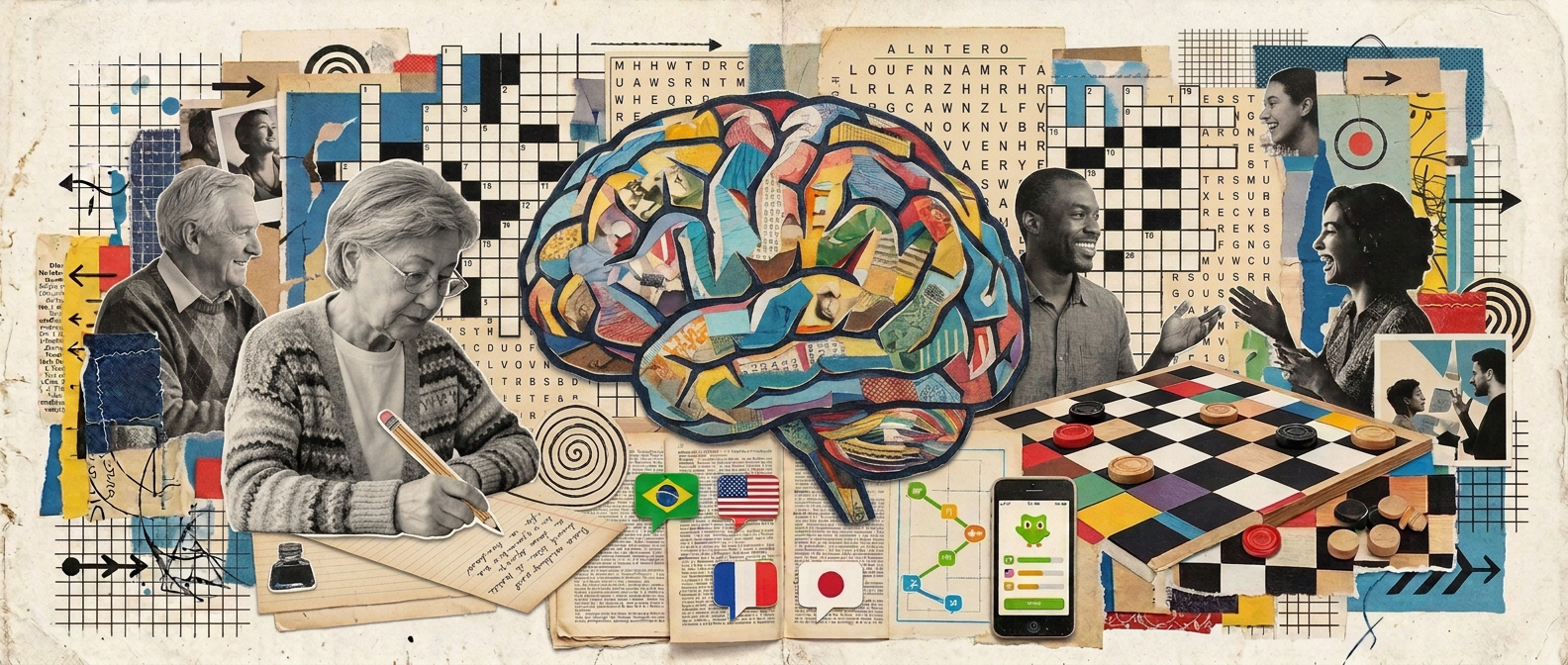
AUGUST/SEPTEMBER 2026 | n.º 8 | Science shows that the human brain remains capable of transforming and adapting itself throughout life, and that language is one of the most powerful tools for maintaining cognitive vitality CREDIT: ILLUSTRATION C. FLEURY WITH FIREFLY
Aging does not affect cognition uniformly. Some functions lose some speed: we process new information more slowly, we have more difficulty dividing our attention between several tasks at the same time, and it takes us longer to learn something new. On the other hand, vocabulary and knowledge accumulated throughout life continue to grow. In old age, we learn less by speed and more by the ability to connect the new to what we already know. This has an important practical consequence: teaching strategies that value life experience and the personal meaning of the content work much better for older people than methods that require rapid memorization.
In addition, magnetic resonance imaging research shows that the aging brain has a surprising capacity for compensation: when one region loses efficiency, others come into action to fill the gap. The older brain does not give up — it finds alternative paths.
Among all cognitive functions, language is the one that best resists changes in aging. And the important thing is that it’s not just a means of communication, but the system by which we organize our thoughts, access memory, and construct meaning.
Do you know why we hardly retain memories from our first two or three years of life? One explanation is that, at this stage, language is not yet developed. It is through words that we can “revisit” an experience soon after living it, telling someone about it or mentally recalling it. Without this revisiting, memory does not consolidate. In other words, language is a powerful facilitator for memories to form and become fixed.
It is through words that we can “revisit” an experience soon after living it, telling someone about it or mentally recalling it. Without this revisiting, memory does not consolidate.
Throughout life, each new word acts as a mental shortcut: it condenses a set of information into a single concept and frees up space to think in a more complex and organized way. The richer a person’s linguistic repertoire, the more efficient their cognitive functioning is, at any age.
In old age, maintaining and expanding language skills is like using an anchor to strengthen all cognition. An older person who continues to enrich his/her vocabulary by reading and writing also preserves a sharper memory, more flexible thinking, and a greater capacity to continue learning.
Reading and Writing: Much More Than Letters
Reading and writing are probably the most complete cognitive exercises that exist. When we read, our brain needs to simultaneously recognize words, integrate their meaning, make inferences about what is not explicit, and verify if the text makes sense. All this while mobilizing memory, attention, and executive functions in an integrated way.
Writing requires even more: it is necessary to plan what you want to communicate, organize ideas in a logical sequence, choose the right words, activate the movement of hands and fingers, and monitor whether the result is clear. Writing a diary, a memoir, or a letter is, without exaggeration, a complete cognitive workout. And if it’s done by hand, on paper, even better for cognition!
Studies show that people who maintain regular reading and writing habits tend to perform better on neuropsychological tests, even when they have low levels of education. This suggests that these practices can compensate, at least partially, for the effects of limited formal education throughout life.
Studies show that people who maintain regular reading and writing habits tend to perform better on neuropsychological tests, even when they have low levels of education.
For those who have been away from reading and writing for decades, resuming these activities has an even more significant effect: it reactivates little-used neural circuits, stimulates cognition, expands linguistic repertoire, and strengthens self-esteem. And it’s never too late.
Cognitive reserve: the secret of a mind that withstands time
There is a concept called cognitive reserve: the brain’s ability to resist changes and continue functioning well, even when structural changes due to age or disease begin to occur. Imagine the brain as a good road network: it’s not just how many roads there are that matters, but how they connect. A brain with efficient connections finds shortcuts, avoids obstacles, and maintains flow even when some roads need repairs.
Linguistic activities are one of the main ways to build this reserve. Studies indicate that complex mental activities, such as reading, doing crossword puzzles or word searches, or even playing checkers, can reduce the risk of developing dementia. This does not mean that the person will never have a disease like Alzheimer’s, but rather that it will take longer for symptoms and loss of functionality to appear. An impressive benefit for something so accessible and enjoyable.
Stimulating the mind with cognitive training is a common recommendation for maintaining cognition in typical aging and in the face of cognitive decline. But there is no single way to train: studies show that activities such as crossword puzzles, done systematically, can generate effects equal to or even better than computer games developed specifically for this purpose. In a study conducted with people with mild cognitive impairment followed for a year and a half, those who engaged in solving crossword puzzles lost less volume in the hippocampus, a region essential for memory and one of the first affected in Alzheimer’s, compared to those who interacted with computer games.
Stimulating the mind with cognitive training is a common recommendation for maintaining cognition in typical aging and in the face of cognitive decline. But there is no single way to train.
Learning a new language
Studies on bilingualism bring equally encouraging findings. People who speak two (or more) languages, even if they learned the second language in adulthood, show more efficient brain activation patterns. In bilingual seniors, cognition remains more preserved even when there are signs of brain atrophy.
A recent study compared a group of elderly people who used the Duolingo app for 16 weeks with another group that did traditional cognitive training. Both had similar gains in executive functions. The difference? Those who learned the language reported more pleasure, which greatly increases the chances of maintaining the habit.
Connecting the dots
Learning in old age presents specificities that should be considered. In general, there is a greater dependence on meaning and context, a need for a slower pace, and greater importance of repetition and distributed practice. Motivation also plays a central role, often driven by the personal relevance of the content. In this sense, welcoming, collaborative learning environments free from excessive pressure tend to favor engagement and information retention. Multimodal approaches, which combine visual, auditory, and motor stimuli, also contribute to optimizing cognitive processing.
Education in old age should be understood not only as the transmission of knowledge, but as a form of cognitive and social intervention. Educational programs that incorporate linguistic activities, especially reading and writing, have demonstrated several positive effects, such as increased discourse complexity and improved episodic memory. Episodic memory is a type of long-term memory responsible for storing specific personal experiences linked to a particular context of time and place; that is, it is the memory we have of “what,” “when,” and “where” something happened.
In addition, educational programs that explore the use of oral and written language can promote social engagement when developed in groups, representing a pleasurable activity among people who share the same age group. In addition to cognitive benefits, these practices promote autonomy, social participation, and quality of life.
In the Brazilian context, studies at the interface between language and aging have shown that regular literacy practices can mitigate the effects of aging on cognition, acting as protective factors. These findings reinforce the need for public policies that encourage lifelong learning, with special attention to the elderly population. Educational programs should value the participants’ experience, promote cognitively stimulating activities, and encourage the continuous use of language in different contexts.
Promoting learning in old age is, therefore, investing in public health, social inclusion, and dignity. Aging does not represent the end of learning, but a transformation in its dynamics. The brain remains plastic and capable of adaptation, especially when stimulated in a meaningful and contextualized way. In this scenario, language, and in particular reading and writing, occupy a central position, functioning simultaneously as a learning tool, a mechanism for cognitive protection, and a means of social participation.
Promoting learning in old age is, therefore, investing in public health, social inclusion, and dignity. Aging does not represent the end of learning, but a transformation in its dynamics.
More than ever, it is necessary to recognize that learning has no age limit. Continuous engagement with language throughout life not only sustains cognition but also expands the possibilities for interaction, autonomy, and well-being. Investing in reading and writing practices in old age is, ultimately, investing in quality of life and in building more active, meaningful, and cognitively healthy aging trajectories.