Janaina Weissheimer Full Professor in the Department of Modern Foreign Languages – UFRN Collaborator at the Brain Institute – UFRN CNPq Researcher General Coordinator of the National Network of Science for Education – Rede CpE
Over a lifetime, this constant exercise mobilizes a cognitive reserve that, among other benefits, can protect our brain from the cognitive decline that we naturally experience as we age.
And there’s more, the effect was proportional to the number of languages the person spoke: the more languages, the slower the aging.
If research like this reaches those responsible for public policies, the culture of bilingualism and multilingualism may become more valued and encouraged in our basic education.
Janaina Weissheimer Full Professor in the Department of Modern Foreign Languages – UFRN Collaborator at the Brain Institute – UFRN CNPq Researcher General Coordinator of the National Network of Science for Education – Rede CpE
JUNE/JULY 2026 | n.º 7 | Study shows that multilingual people are half as likely to show signs of cognitive aging as people who speak only one language
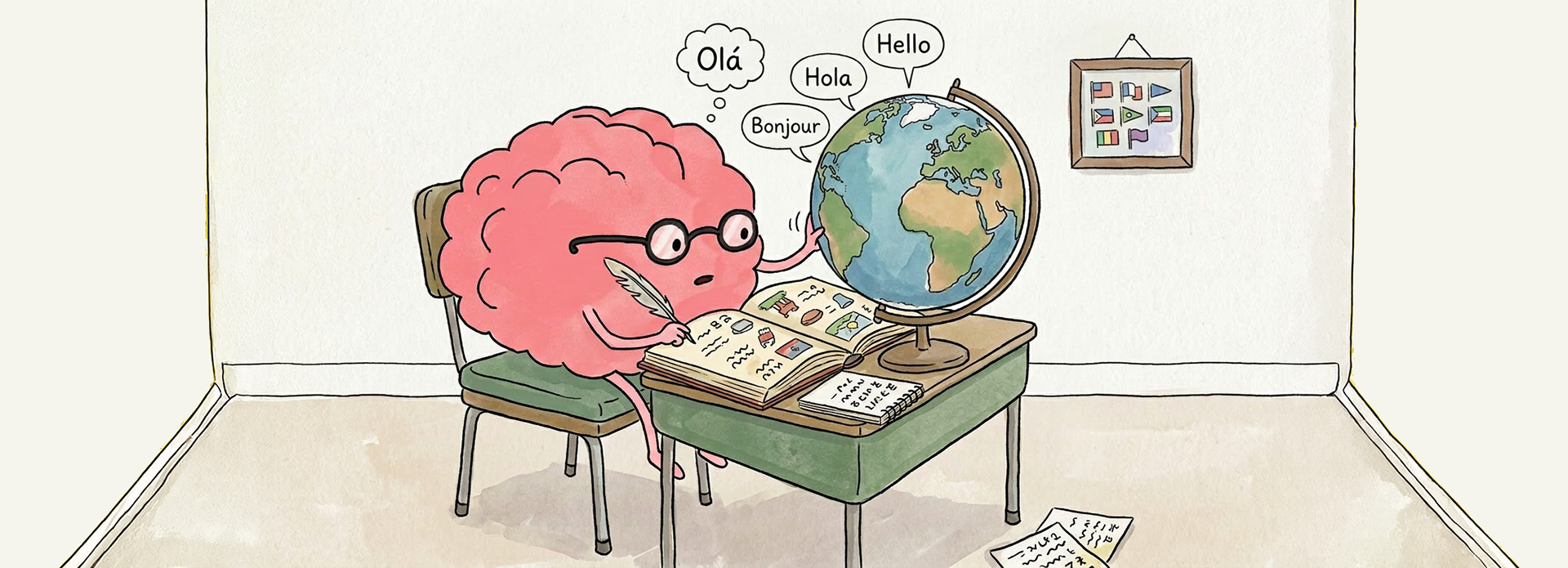
ILLUSTRATION: C. FLEURY WITH GEMINI
Did you know that our aging trajectory is influenced by risk factors, but also by protective factors? These include healthy eating, regular physical activity and, more recently, the regular use of more than one language, also known as multilingualism.
Over a lifetime, this constant exercise mobilizes a cognitive reserve that, among other benefits, can protect our brain from the cognitive decline that we naturally experience as we age.
To understand how multilingualism can slow down aging, imagine that you work and put a little money into savings every month, throughout your life, to have a reserve when you retire. Now, consider that a multilingual person builds cognitive savings, generated from the mental exercise of sometimes activating and sometimes inhibiting languages. Over a lifetime, this constant exercise mobilizes a cognitive reserve that, among other benefits, can protect our brain from the cognitive decline that we naturally experience as we age.
A recent study published in the journal Nature Aging shows that multilingual people are half as likely to show signs of cognitive aging as people who speak only one language. This study advances previous ones in two ways.
First, it uses a large and geographically diverse sample, with more than 80,000 healthy participants residing in 27 European countries. This allows inconclusive results from previous studies, with reduced samples and populations that already presented dementia and/or cognitive decline, to be re-evaluated.
Another advancement of the study in question is the research methodology used, which is quite innovative, with a computational approach that allowed the calculation, for each individual, of what the researchers called the biobehavioral age gap, that is, the difference between chronological age – the number of years a person has already lived – and projected age – which considers physiological, socioeconomic, and lifestyle factors, such as educational level.
Biobehavioral Gaps
In general, scores greater than zero indicated rapid aging, and scores less than zero indicated slow aging. For example, if a participant was 53 years old and had a projected age of 60, the biobehavioral gap was 7 years, and this individual was aging rapidly. Next, the researchers compared these biobehavioral gaps of all participants with the number of languages they spoke.
The result? People who spoke only one language were twice as likely to have a high biobehavioral gap, that is, to age faster. And there’s more, the effect was proportional to the number of languages the person spoke: the more languages, the slower the aging.
And there’s more, the effect was proportional to the number of languages the person spoke: the more languages, the slower the aging.
We know that in Europe, closer borders and a culture of migratory movements have made multilingualism the norm and not the exception. Brazil, on the other hand, is a country of continental dimensions and is essentially monolingual. Although more than 200 languages coexist daily in the country, including languages of indigenous peoples, border communities, and immigrants, there are only two official languages: Brazilian Portuguese and Brazilian Sign Language. Therefore, caution is needed when extrapolating the findings of the study to the Brazilian context.
Public Policies
Even so, the study brings important reflections on the Brazilian situation. If research like this reaches those responsible for public policies, the culture of bilingualism and multilingualism may become more valued and encouraged in our basic education. In fact, there is precedent.
If research like this reaches those responsible for public policies, the culture of bilingualism and multilingualism may become more valued and encouraged in our basic education.
The National Education Council (CNE) issued Opinion CNE/CEB No. 02/2020 in 2020, which addresses the National Curriculum Guidelines for Plurilingual Education, providing clear guidance on the inclusion and promotion of bilingual and plurilingual practices in the Brazilian educational system.
The importance and urgency of approving this opinion lies in its ability to offer a regulatory framework that facilitates the implementation of pedagogical practices that value our linguistic and cultural diversity.
In the long term, with public policies that regulate access to multilingualism, we can promote healthier aging trajectories, in which the elderly population has a longer functional life and fewer cognitive symptoms associated with neurodegenerative diseases.
Furthermore, at the educational level, we can take an important step towards guaranteeing equitable and inclusive learning opportunities, as proposed by UNESCO’s 2030 Agenda, which includes a society that treats speakers of other languages, whether majority or minority, with more respect and fairness.
So, are you excited to learn a second language? There’s still time.