





Sonia Maria Guedes Gondim
Professor of the Postgraduate Program in Psychology
Federal University of Bahia
The development of a repertoire of socio-emotional skills (SES) is part of our socialization process to deal with the various spheres of life, both personal and professional.
We all frequently witness the growth of manifestations of verbal intimidation and physical aggression against teachers and the school environment.
Identifying and understanding how emotions manifest in behaviors is crucial for effective pedagogical practice.


Sonia Maria Guedes Gondim
Professor of the Postgraduate Program in Psychology
Federal University of Bahia
JUNE/JULY 2026 | n.º 7 | Competencies can help teachers preserve well-being, mental health, and improve relationships with others and the world
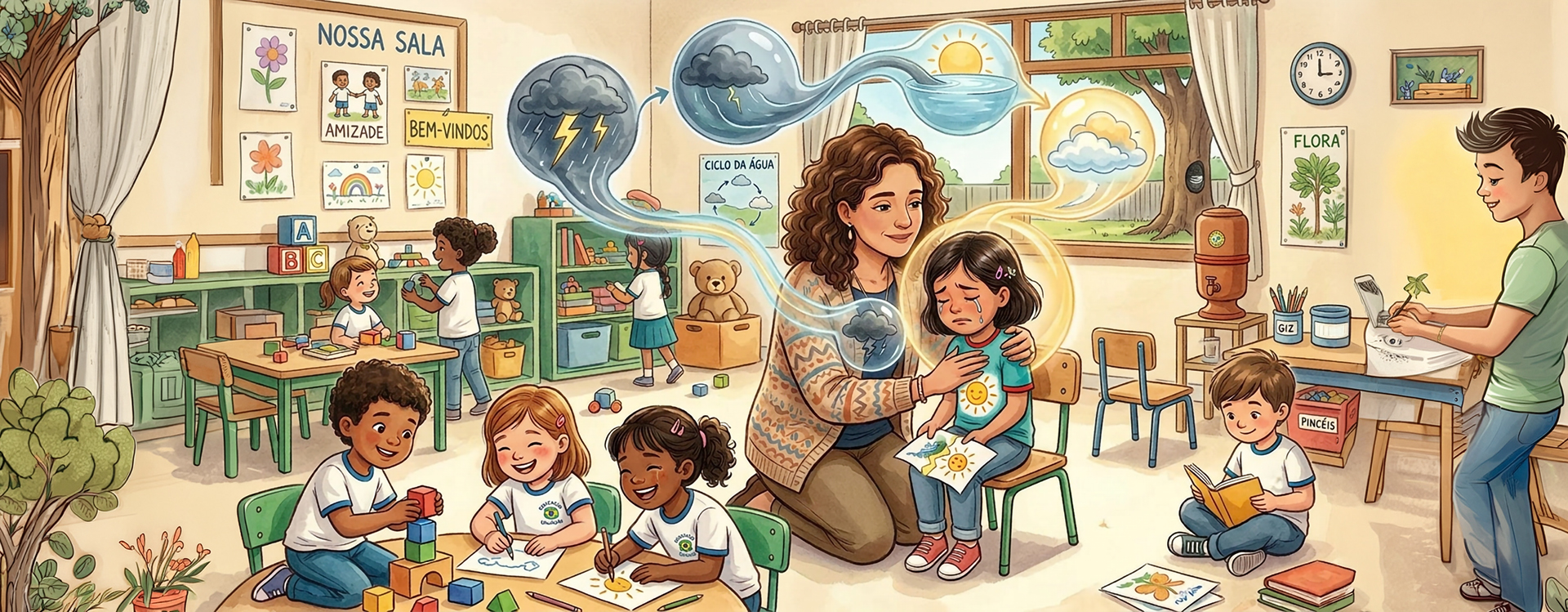
ILLUSTRATION: C. FLEURY WITH GEMINI
It would be a challenge to imagine a life without emotions. Our species probably wouldn’t have survived throughout the entire process of human development. Emotions fulfill several vital functions: they serve to express internal states, communicating to others what we are feeling, they contribute to the functioning of basic cognitive processes (learning, memory, thought, creativity, etc.), and they ensure the quality of our social interactions, in addition to ensuring rapid adaptive responses to internal or environmental stimuli that put us at risk. But how to deal with emotional demands in the classroom?
Emotional manifestations can be of two types. The appetites and passions, which make up the first type, are unstable and intense, being quite challenging to deal with daily. Affections or feelings, the second type, are more stable and tend to last, related to cognitive processes, especially thought and self-reflection.
Considering that we are social beings and react to the environment in which we are inserted, the quality of life and our well-being are associated with how we manage emotional events that arise in our personal and professional daily lives. The development of a repertoire of socio-emotional skills (SES) is part of our socialization process to deal with the various spheres of life, both personal and professional.
The development of a repertoire of socio-emotional skills (SES) is part of our socialization process to deal with the various spheres of life, both personal and professional.
Interactions and regulation of emotions in the school environment
Basic education has as its central purpose the development of people, promoting the integral formation of students. Although still undervalued compared to teaching at the higher education level, teaching in basic education is much more complex. In addition to promoting core learning for cognitive and emotional development, the primary school teacher presents themselves as an adult role model, in which children mirror themselves to guide their actions, and to form attitudinal and behavioral patterns of sociability, whose foundations are based on strong affective bonds with students. This, however, is becoming a daily challenge.
We all frequently witness the growth of manifestations of verbal intimidation and physical aggression against teachers and the school environment. The 1st Bulletin of the School that Protects: Data on violence in schools points to the alarming increase in cases of extreme violence, including the use of firearms in several schools throughout the country. It also warns that, in 2023 alone, there were 13,117 recorded victims of interpersonal violence in Brazilian schools. Between 2013 and 2023, the total number of victims reached over 60,000, with approximately 9,000 victims of self-inflicted violence (acts against oneself, such as suicide attempts, self-harm, etc.). The latter grew alarmingly during this period, jumping by 900%.
We all frequently witness the growth of manifestations of verbal intimidation and physical aggression against teachers and the school environment.
The Influence of Socio-Emotional Competencies on Pedagogical Practices
Teachers’ socio-emotional competencies can be defined as “attitudinal, cognitive, and behavioral patterns resulting from the articulation of a broad set of knowledge, skills, and motivations to appropriately deal with emotional and social demands inherent in teacher-student, student-teacher, and student-student relationships in the classroom context.”
SECs are based on four dimensions: (i) positive attitudes towards the challenges of learning and the regulatory process itself, (ii) emotional awareness of the affective states of the teacher and their students, (iii) the ability to demonstrate sociability, enhancing gains in interactions, and (iv) a greater perception of autonomy for self-regulation.
Emotional regulation is an important dimension in teaching activity, as it ensures the best use of strategies to deal with events in the classroom. Emotional regulation serves both hedonic (pleasure) and instrumental (achieving a goal) reasons. These instrumental objectives, in the case of teaching activity, are linked to helping students better manage their own emotions.
Identifying and understanding how emotions manifest in behaviors is crucial for effective pedagogical practice. Teachers’ emotions have repercussions in the classroom environment, and self-awareness of affective states helps prevent the escalation of tensions, as well as favoring the use of more relevant pedagogical strategies to deal with anxiety-generating learning situations. Positive emotions from teachers can increase student engagement and motivation, contributing to improved performance.
Identifying and understanding how emotions manifest in behaviors is crucial for effective pedagogical practice.
Regulatory processes, fundamental in the expression of CSE, are a response to the emotional demands of life in all its spheres. The belief that emotions are good or bad and whether they are controllable or not is implicated in attitudes and behaviors related to everyday emotional demands, especially at work. The belief that emotions can be controlled improves mental health, just as the belief that emotions are bad leads us to tolerate stress poorly, increasing the risks of mental illness.
Thus, in nature, emotions respond to a dual need for adaptation: automatically, preserving the species, and in a controlled way, expanding the scope of regulatory control in the face of unforeseen situations. The controlled mode is responsible for learning socio-emotional skills. Learning to use the best strategy to deal with each situation requires the ability to understand the emotional demands of the context and mental flexibility to decide.
Accepting uncomfortable affective states is also fundamental. People who accept their negative thoughts and emotions, without wearing themselves out by constantly fighting against them, respond less negatively to stressors. Accepting a negative emotional state is not the same as accepting the situation. Strictly speaking, self-awareness and self-acceptance of temporarily uncomfortable states contribute to ensuring more adaptive future choices. The environment and the socialization process shape the emotional repertoire, which opens up space for new learning that constitutes the professional background. Individual differences, such as the teacher’s experience and maturity, also have effects on emotional intelligence.
Improving our ability to deal with personal and others’ emotions can help us preserve our well-being, our mental health, and improve relationships with others and with the world. It is an essential requirement in the professional practice of educators.