





Elisa Martins
Journalist, special for Yvirá
Giselle Soares
Journalist, CpE Network
Just like reading itself, reading clubs go against the grain of the rush of modern times. They exercise critical thinking, mindfulness in the present, and value everyone’s impressions.
In addition to being “the soul of peripheral neighborhoods,” says the professor, reading clubs bring not only a discussion of the aesthetics of literature, but also the capacity for imagination, for creating other worlds, problem-solving, conflict mediation, and collective engagement.
For the professor, the reading club in the classroom helps the class experience a less hierarchical methodology. Students engage with the content and feel motivated to participate in discussions and give their opinions.
The meetings take place in the school library, a time that strengthens emotional bonds, stimulates the holistic development of children, and sows the seeds of a love for books and reading, beyond school obligations.


Elisa Martins
Journalist, special for Yvirá
Giselle Soares
Journalist, CpE Network
AUGUST/SEPTEMBER 2026 | n.º 8 | Literature and discussion spaces strengthen emotional bonds, stimulate development and learning, and sow the love of books
Valuable spaces for reading and discussing literary works, book clubs became popular in Brazil starting in the 2000s, against the trend of bookstore closures, and expanded mainly with the pandemic, reinforcing the need for socialization, exchange, and interaction, even on online platforms. Today, book clubs are also beacons of resistance and attention for women’s, LGBT+, Black, and Indigenous movements. At the same time, they prove relevant in the school environment, where they bring benefits to both students and teachers.
“Reading is a solitary activity and therein lies one of its magics. However, we digest what we read better when we talk about it. And reading clubs provide this opportunity. They bring together people who have read and become interested in the same work and can exchange ideas about it and other similar interests. It is a moment of exchanging perceptions and feelings, which also ends up being very therapeutic,” says Ana Carolina Teixeira Pinto, professor of Hispanic Literature, adjunct coordinator of the Bachelor’s Degree in Letters: Portuguese and Spanish, at the Federal University of the Southern Frontier (UFFS – Realeza Campus) and one of the coordinators of the Leia Mulheres – Realeza project, a reading club with monthly meetings about works written by women that emerged in 2019, from the Me Too movement, to combat gender violence.
In reading clubs there is no hierarchy, and everyone has their turn to speak, organized by a mediator who raises different questions about the work and ensures that everyone can comment. “Just like reading itself, reading clubs go against the grain of the rush of modern times. They exercise critical thinking, mindfulness in the present, and value everyone’s impressions,” says Professor Ana Carolina Teixeira Pinto.
Just like reading itself, reading clubs go against the grain of the rush of modern times. They exercise critical thinking, mindfulness in the present, and value everyone’s impressions.
The increase in reading clubs – and consequently in readers – is also related to growing community work in Brazil, says Professor Claudiana Alencar of the State University of Ceará (UECE), a reading mediator in community-based libraries and coordinator of the “Viva a Palavra: language, peace and resistance circuit of black youth from the outskirts of Fortaleza”.
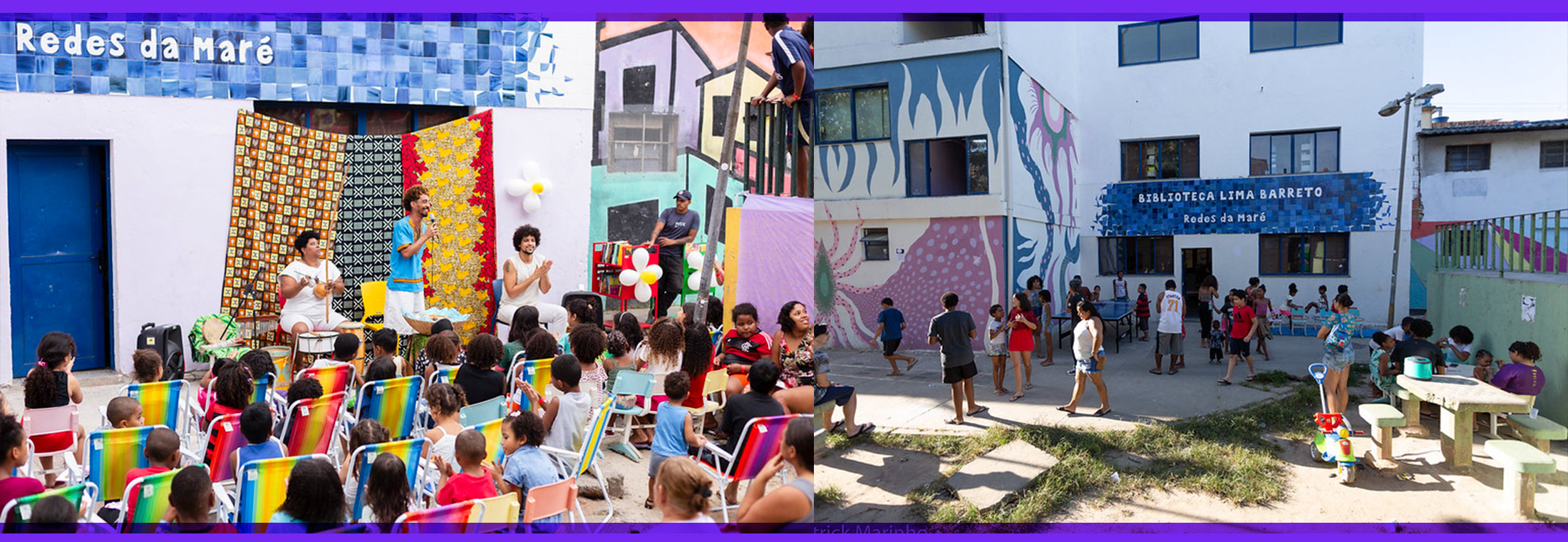
“Cultural producers, reading mediators have faced a great challenge in neighborhoods with high vulnerabilities, but they have opened their homes and built reading spaces, changing what would be territories marked by violence, such as favelas, peripheries and suburbs. These territories are being occupied by young people, women, the indigenous population and the black population, in a true cultural change,” says Claudiana Alencar.
The change began in the 2000s, she says, with the rise of literary gatherings as meeting places in the peripheries. “In these gatherings, there begins to be an incentive for resistance literacy, as called by Professor Ana Lúcia Silva Souza, from UFBA, driven by youth movements, organized in collectives,” says Claudiana, who also studies groups formed by women and is a member of the “Elaspoemas Collective: peripheral writings.” “Reading clubs grow in this profusion of spaces of hope in the peripheries.”
In addition to being “the soul of peripheral neighborhoods,” says the professor, reading clubs bring not only a discussion of the aesthetics of literature, but also the capacity for imagination, for creating other worlds, problem-solving, conflict mediation, and collective engagement: “It’s an open microphone, like a popular platform in the peripheries.”
In addition to being “the soul of peripheral neighborhoods,” says the professor, reading clubs bring not only a discussion of the aesthetics of literature, but also the capacity for imagination, for creating other worlds, problem-solving, conflict mediation, and collective engagement.
Integration with the Classroom
In the classroom, reading clubs reinforce the empowerment of learning paths and integrate into the teaching-learning process. “It was a different way to motivate students with a club within the university, with readings in Spanish, in a horizontal debate. Students understand that they too can have their own interpretations and experiences. We are pleasantly surprised by the ideas of others, we learn together. And they take this forward later, with their students,” says Professor Ana Carolina Teixeira Pinto, who also coordinates a reading club at the university about works in Spanish, called “Libros con té” (Books with tea, in English).
For the professor, the reading club in the classroom helps the class experience a less hierarchical methodology. Students engage with the content and feel motivated to participate in discussions and give their opinions – in a human conversation, without room for consultations with artificial intelligence.
For the professor, the reading club in the classroom helps the class experience a less hierarchical methodology. Students engage with the content and feel motivated to participate in discussions and give their opinions.
“The younger the students are when they start with a reading club activity, the more they will develop. It’s about going beyond reading a book and writing a summary: it’s about talking about what was read, sharing it with classmates. Thus, from a young age, students learn that people want to hear about it. It is also an exercise in developing orality and articulation that helps develop critical awareness, debate, and listening to others, who may think differently,” says Ana Carolina.
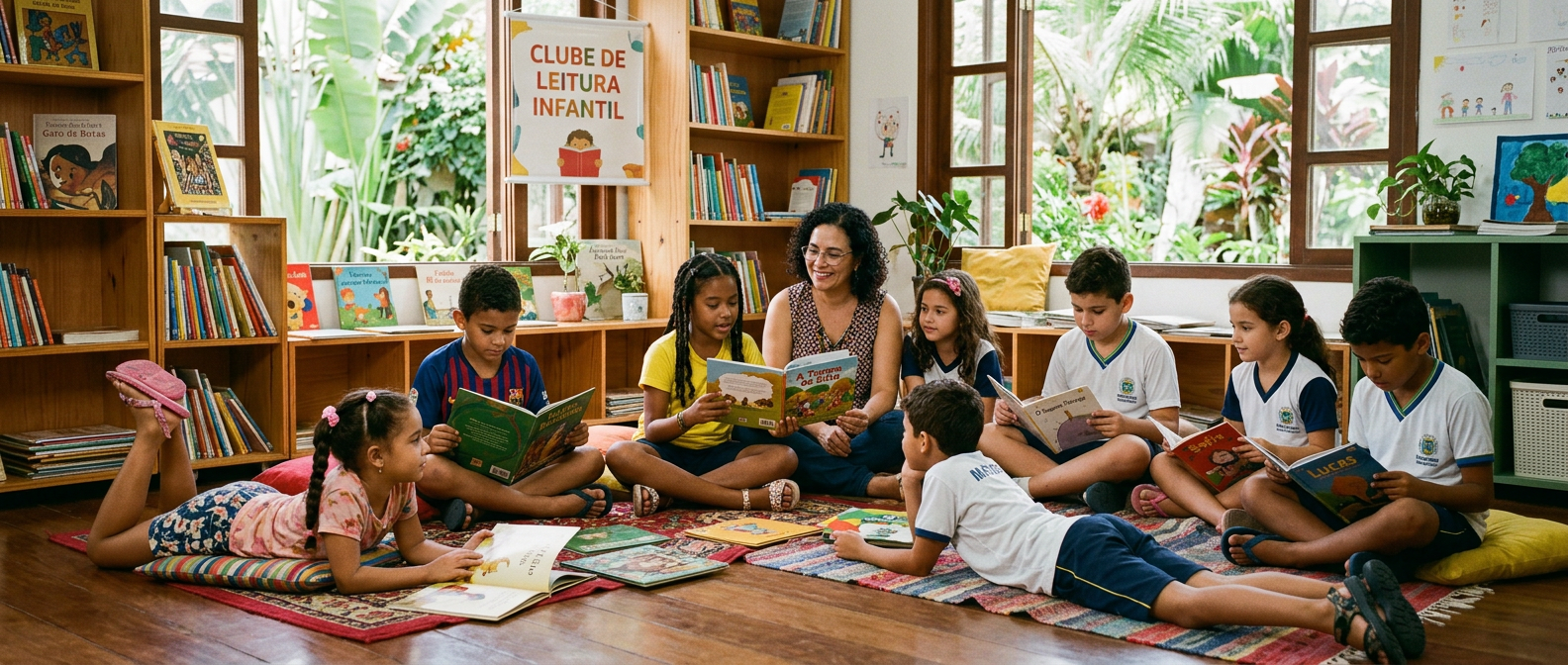
In early childhood education, reading clubs transport children to magical places, where it is possible to dream and be whatever you want, face villains, discover incredible stories… all you need is a book in hand and a lot of imagination, says Karinne Alves, a literacy teacher in the municipal public school system in Ouro Branco, Minas Gerais. In March 2026, when the municipality’s Department of Education acquired children’s literature books for first-grade students in public schools, she set up a children’s reading club. “With the books in hand, my students and I meet weekly to discuss the stories contained within them, their content, and their objectives. In this reading practice, while the students are still in the process of learning to read, they listen to me read the story selected for that week,” she explains.
“However, before we begin reading, the children participate in a preparatory ‘ritual.’ They have fun singing games and prepare themselves emotionally for story time. I present the book, we talk about the illustrations, identify the title, and the names of the authors and illustrators. We discuss how the writing is presented, the format of the book, and other details that arise according to the students’ interest and contribution. It is enchanting to see them handle the books intentionally and appropriate the book in such a meaningful way, understanding the symbols that make up this material.”
Karinne affirms that the children go beyond what they have heard and bring personal contributions regarding the topic. The meetings take place in the school library, a time that strengthens emotional bonds, stimulates the holistic development of children, and sows the seeds of a love for books and reading, beyond school obligations.
The meetings take place in the school library, a time that strengthens emotional bonds, stimulates the holistic development of children, and sows the seeds of a love for books and reading, beyond school obligations.
Other Worlds and Possibilities
In early childhood education, reading clubs work well when focused on local literature, suggests Professor Claudiana Alencar, from UECE. “It’s work associated with pleasure, playfulness, the local, and the child’s experience. Indigenous literature poems are strong in this sense, because children are very connected to nature, to animals, to the idea that we are not different. It’s a way to bring the child to literature and that refers to the strength of reading clubs,” she says, reinforcing the meaning of shared reading in the clubs based on solidarity, friendship, and empathy.
For older school age groups, reading becomes even more important as a “projection” of other possibilities and representations. “Children and young people begin to identify with that literature and realize that what awaits them is not a dead end, but a life with other worlds, other paths. Inspirational trajectories emerge for indigenous people, black people, women, bringing new ways of believing and being,” she says. “Reading plays a major role in this regard.”
The practice and its benefits extend to the school community. Professor Gabriela Arruda, pedagogical director of early childhood education in the private school system of São Paulo, experiences a reading club for teachers. The objective, she says, is the development of the interpretive capacity of the teaching staff.
“How can we train a prepared adult if that adult has never stopped to situate their own work within a larger narrative? (The Italian educator) Maria Montessori was precise in stating that ‘the secret of good teaching is to consider the child’s intelligence as a fertile field where seeds can be sown and grow under the warmth of an ardent imagination.’ This requires an equally vivid imagination from those who teach, nourished by genuine study,” says the director.
The format of the teachers’ reading club is bi-weekly, with prior individual reading and then a guided discussion. The first title read by the group was “To Educate Human Potential,” by Maria Montessori.
“The effects of the club are observable and consistent. The pedagogical meetings present conceptually more grounded discussions. Observations about children become interpretive, not just descriptive. Team cohesion is broadened through shared thinking, which is distinct from the cohesion produced by coexistence or alignment of procedures. Differences in the interpretation of the same text reveal differences in practice, and this is a diagnostic fact that no other formative format accesses with the same clarity,” enumerates Gabriela Arruda.