





Elisa Martins
Journalist, special for Yvirá
Parents and caregivers can also encourage handwriting practice among children.
Pais, mães e cuidadores também podem incentivar a prática da escrita à mão entre as crianças.


Elisa Martins
Jornalista, especial para Yvirá
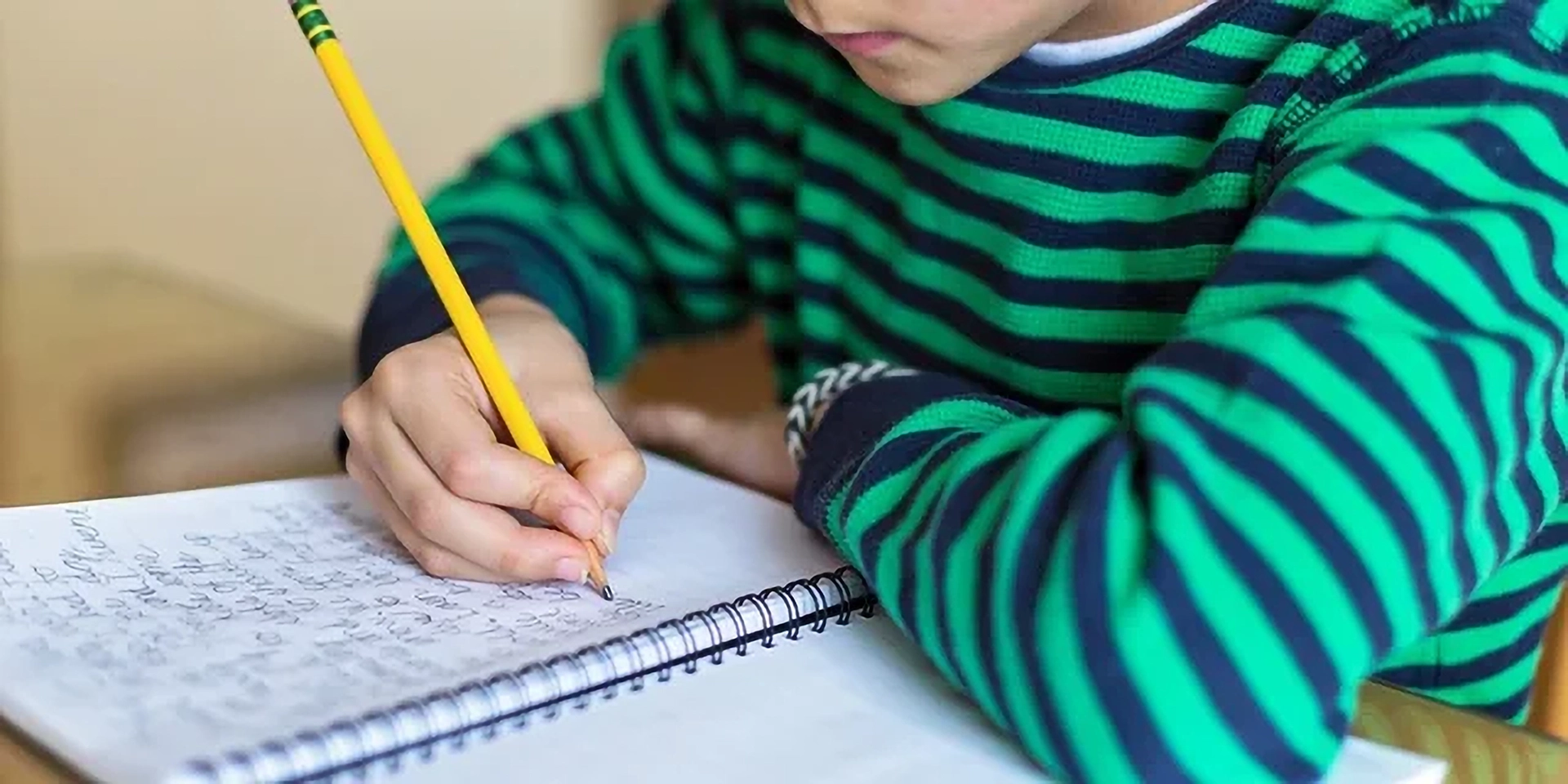
APRIL/MAY | nº6 | Beyond school learning, rediscovering this practice reveals numerous benefits, from memory to concentration, information processing, temporal and spatial organization
Ilustration: C. Borges with Gemini.
In an era where cell phones, tablets, computers, and other digital technologies are increasingly present in our daily lives, handwriting is losing ground. Very present in the early years of literacy, it diminishes throughout school life and even more so in adulthood, replaced by keys and keyboards. However, rediscovering the habit and enjoyment of handwriting brings numerous benefits to children, as well as to young people and adults. YVIRÁ spoke with experts to understand the different meanings of this practice for those who write. And suggests, further on, how to encourage handwriting in the classroom and at home. After all, writing has been part of our history for a very, very long time.
“Homo sapiens probably spent almost 70,000 years just speaking. Writing is very recent, about 5,000 years old. And it emerged to allow the permanence of speech, so as not to depend only on sound. Writing records the sounds of speech, this is clear in studies of education and literacy”, says Professor Maria Regina Maluf, from the Department of Psychology of Learning, Development and Personality at the Institute of Psychology of the Pontifical Catholic University of São Paulo (PUC-SP).
From this need to record the sounds of speech, different writing systems were born, recalls the specialist in Educational Psychology. Some of these systems even required a person to learn thousands of characters. The invention of the alphabetic system dates back 4,000 years and simplified writing. The system we inherited from Latins and Greeks has 26 letters and is the most widely used system in the world.
“All civilizations we know have used their hands to represent things. There are many traces of this”, says Professor Maria Regina Maluf. “And, since the invention of writing, the hand has been used to represent the signs of the alphabetic system that represent speech. But not only the hand, other objects as well, whether a stick, something to scratch on the ground, to scratch in the clay. Today, with technological resources, none of that would be needed anymore, not even paper.”
It wouldn’t be necessary – in theory. Does it seem sufficient to use technology and tools that eliminate the need for paper and pencil? Research has not yet offered a conclusive answer on the subject.
“We can reflect on these questions from different perspectives, but it is interesting to start with utility. What is the purpose of writing? And why write by hand?” reflects the specialist.
For the early years of elementary school, answering this question is easy: “Handwriting is a very important focus in the context of learning to write and read. Today, research is very clear in showing that writing and reading are two sides of the same coin,” says Maria Regina Maluf.
Handwriting offers autonomy, independence, and flexibility, she adds, and it’s good to remember that it doesn’t depend on batteries or electricity. But there’s more.
Handwriting is a very important focus in the context of learning to write and read.
From Planning to Paper
At the beginning of school life, there is a gradual but continuous expansion of motor coordination, which requires the involvement of the body as a whole: eyes, spine, shoulders, elbows, wrists, fingers. This contributes to the improvement and maturation of writing skills, explains Professor Mariluza da Silva Lucchese, Master in Science Education with extensive experience in pedagogical coordination in Elementary School and in teaching in Elementary and High School and member of the CpE Network.
From the 1st to the 3rd year of Elementary School, she reinforces, writing by hand is one of the most demanding, intense and frequent activities, both in the classroom and in homework. In the sequence of school life, writing continues to be an important activity, but, as the years advance, the specialist warns, the graphic record shares space with other activities, other tools and proposals that constitute the context of school production.
“This is one of the reasons why, during middle school, students decrease their consistency and enjoyment of writing, and teachers offer other resources and methodologies, reducing the demand for written records. The fragmented time of classes seems to dictate a rush to produce quality written work,” says the educator.
In addition to these, there are other obstacles to consistent handwriting. Since the 1980s, traditionally in Brazil and Latin America as a whole, much attention has been paid to writing, but not to writing fluency, which is acquired mainly when practicing handwriting.
“This involves a whole graphomotor process, from planning what to write, to the movement with the hand, the pressure on the paper. All of this is very important because it helps the child to strengthen the relationships between letters and sounds and to strengthen this ability to write more quickly, cohesively and coherently,” says Professor and neuroscientist Renan Sargiani, PhD in School and Human Development Psychology from the University of São Paulo (USP), with part of his doctorate carried out at the Graduate Center of The City University of New York (GC-CUNY) and postdoctoral studies at the Harvard Graduate School of Education.
“When we write by hand, we stop to think about which word to write, how it should be written, we scribble, we write, we stop, we write again. Today, unfortunately, we have worked little on fluency in writing, and handwriting itself, as a skill that prepares the child to be a fluent writer, not a professional writer, but a person who writes – including on the computer, in the future,” adds the also founder of the Edube Institute, which promotes evidence-based educational practices.
In recent years, he says, several countries have invested in research on the practice of handwriting. Portugal and Finland, for example, have recent studies linking the need for greater encouragement of handwriting to benefits such as better learning and memory development.
“Writing and reading are different skills, but they depend on a common base and share many elements in common. In reading and writing, it is necessary to first learn what the letters are and what sounds they represent, that is, the graphemes and phonemes. The union between graphemes and phonemes, which we call orthographic mapping, consists of the connection of letters, their sounds and the meanings in the pronunciation of words. And precisely the main task of those who are learning to read and write is to learn this orthographic mapping. For this, it is very important not only to practice visually, auditorily or orally, but also graphomotor skills, which involve this practice of handwriting,” says Sargiani.
Cognitive behavioral studies, the expert explains, show that children who practice handwriting generally have a greater ability to retrieve the sounds of words, select the correct graphemes, and produce the correct letter form. In practice, this means that handwriting strengthens letter learning and the development of writing (and reading), contributing to orthographic mapping.
“The formation of orthographic memory, which will be very important from orthographic mapping onwards, also helps to better integrate the cognitive, linguistic, and motor systems in the brain,” says Sargiani. “This is very clear in research, which indicates improvements in content retention and more fluent text production.”
Benefits Beyond Literacy
The benefits are not limited to the beginning of school life. Professor Mariluza da Silva Lucchese points out that handwriting can have different meanings for the writer: it can be a resource, such as a shopping list, or a technique, such as transcribing a passage for memorization or practicing letter type. It can also be a habit, such as producing drafts before typing, or a necessity, such as recording fragments of daily life in diaries or describing emotions.
“In any of these situations, or in others not mentioned, handwriting contributes fundamentally to the construction of knowledge, primarily because handwriting requires presence, that is, being there at that exact moment, thinking or remembering, recording, reading or rereading, rewriting, selecting words, organizing and reorganizing ideas”, says the educator.
Handwriting, therefore, is a process that activates concentration, memory, the ability to synthesize information, and information processing.
“While writing, the student needs to mobilize cognitive learning skills, such as attention, focus, concentration, intentional silence, and self-control,” explains Mariluza. “There are other important motor implications in the student’s relationship with their book or notebook that need to be observed, such as margins, spaces, separations between words and activities, page sequence, that is, spatial organization.
Not competition, but complement
It is worth reinforcing that it is not about seeing handwriting and digital writing as competitors. One does not need to compete with the other, but to coexist and complement each other.
“The motor movements and cognitive skills involved in these two forms of recording involve different contexts in the meaning of learning. In typing, the computer keyboard displays the set of letters of the alphabet and requires the child to identify the letter to be used, for example. In handwriting, the child needs to identify the letter and think about the stroke and translate thought into action,” exemplifies Professor Mariluza Lucchese.
In a situation involving a spelling error or a deviation in the strokes, she adds, the child erases with an eraser. In typing, however, they delete, which is a way of erasing that leaves no marks – and they can even use the available spell checker.
“The eraser marks on handwritten notes teach rewriting, revision, the sense of new opportunities, of doing things differently,” says the educator.
There is also a difference in the time invested in each situation. Writing in a notebook consumes time, patience, and persistence, while typing contributes to the acceleration of thought and time, resulting in a quick completion of the requested task, the educator points out.
Another interesting factor of handwriting is related to memory. Professor and researcher Renan Sargiani reports the existence of studies showing that people who take handwritten notes in various situations, such as classes, lectures, etc., have a greater capacity for storing and consolidating information.
“When we repeat what the other person is saying, the brain does a kind of rehearsal of what is being said. It works like a learning mechanism,” he says.
This doesn’t mean that digital writing doesn’t help with memorization. But the coordination movement of handwriting, which is more difficult than pressing a finger on a key, requires more concentration and reflection on what is being written.
“Handwriting requires this planning, involving cognitive, linguistic, and motor processes. It is necessary to plan the motor skills, the pressure on the paper, the speed of writing, the space on the page,” he enumerates.
Changes in Practice
So-called technological literacy is, and will continue to be, important in the education of children and even into adulthood. On the other hand, experts interviewed by YVIRÁ agree that handwriting brings a complexity that should not be entirely lost to digital writing.
“In-depth studies since the 2000s show that the neural networks activated during handwriting contribute to motor, linguistic, and emotional development,” says Alexandre Tadeu Rosa, a high school teacher and researcher at the Laboratory of Cognitive and Social Neuroscience at Mackenzie Presbyterian University.
The professor says he perceives the benefits of handwriting practice in the classroom. When giving a text plan, for example, when students are thinking about what to do, he advises them, when possible, to prioritize doing the work in their notebooks instead of using an iPad.
“It’s not a matter of prohibiting digital use, but I talk to them and explain the benefits of handwriting. In the first version of an assignment, I guide them to write by hand, I correct it and give feedback. I then suggest that they leave typing for the second version of the text, after this correction and discussion stage,” he says.
“I have also asked them to do some tasks in class that they previously wrote at home. This helps to monitor preparation for writing, organize notes, and discuss the process, without the influence of artificial intelligence and other technologies,” he states.
The gains become apparent throughout the students’ school development, reports the teacher, reinforcing the content, memory, and learning of the students.
“In students who come from a digital writing culture, I notice anxiety when I ask them to write by hand. They want to do the work and finish quickly, but when they start writing by hand they are forced to slow down. Handwriting requires a more active selection of information. It demands managing different levels of language, from the macro to the microstructure of the text, which includes spelling, punctuation, the meaning of the sentence, the paragraph, the number of arguments,” explains the professor.
In classroom practice, he adds, the perception is that students develop a refinement of language that goes beyond lexicon and grammar.
“It’s a refinement of structure, of metaphors, with more elaborate sentences, as if the text gained a deeper meaning, compared to doing the same thing by typing,” he says.
The professor explains that this is a worthwhile process that can be introduced gradually in the classroom, without assigning grades or penalties. On the contrary: it is important that students have emotional security and engage in the task, rather than feeling threatened or pressured by it.
“Sometimes it’s necessary to step away from technology a little and invest in practices that lead our cognitive system to ‘exercise’,” he says.
Handwriting, in this sense, acts as if it retrieves what is in our memory. While mentally planning what to write and how, a whole personal repertoire is also activated, he explains. The practice calls us to know the words, the topics, the text formats. Without consolidated writing, it will not be easy to do this. On the contrary: the process will have gaps, overload the memory, and the difficulty of putting everything that is thought on paper arises.
Let’s get to work!
There is much to be done in the classroom, therefore, to encourage handwriting, beyond the more constant and obvious period of the early years of elementary school. To begin with, teachers can encourage students to plan. Plan the page layout, plan how to make the text look like what is intended, from a note to a letter, an email, a recipe, an essay.
“It is necessary to help the child develop this planning skill. This is metacognition. It is this ability sometimes defined as learning to learn, sometimes defined as reasoning about learning, but which generally means planning before executing,” explains professor and researcher Renan Sargiani.
“Often students already want to do the final version of the text. They say it’s hard work to plan, then to rewrite the text neatly. But, without this planning, the writing doesn’t flow,” he says.
This planning is very different from making copies, a tradition that unfortunately remains present in schools throughout Brazil, says the professor. In this case, it is a type of writing that is basically a reproduction of what someone else has written, without autonomy or reflection in the process.
“It is very important to work with the student on their ability to write attentively, planning and reflecting. To this end, the teacher can plan moments within their subjects when it is necessary to use writing productively. If they are going on a field trip, students can understand how a field trip report works. If they are going to a museum, they can propose that students write a report. They have to write down the name of the place, its physical characteristics, the arrival time, how many people were there and what services were available. It is up to the teachers to help plan this writing. And to give corrective feedback that validates what the student has done, while showing how they can improve in that skill,” he suggests.
One technique that helps to think about these different pedagogical proposals, he says, is the so-called theory of gradual release of responsibility. It starts from the idea of “I do”, then “we do” and then “you do”.
“The teacher can create a text model to show what it’s like. Then, they write together with the students, think, discuss which words to use, and why not others. After that, the activity can be done in small groups, with students also learning from their peers. Then, it would be time for individual practice, in which they receive more assertive feedback from the teacher about specific difficulties, until the student gains more and more autonomy. This is a general principle that applies to any activity and can be used to teach different text genres or simply practice creative writing,” recommends Sargiani.
This can be done for different subjects starting in middle school: “It’s important to remember this transdisciplinarity of writing at this stage. Math, History, and Philosophy teachers also teach writing. In Physical Education class, they can write the rules of a sport, hand in a written assignment about another, or research the impact of a particular physical activity on our bodies. Handwriting can even be part of planning posters and murals about raising awareness of good habits, for example,” he adds.
Engagement and the Love of Writing
The idea of teachers modeling a first written text, and then constructing it together with the students, reiterates Professor Alexandre Tadeu Rosa, is a practice that helps maintain attention in the classroom and has an interesting emotional component, as students feel that the written text is also theirs.
“Engagement is extremely important. And, by sustaining the students’ attention, we can monitor errors and help students persist and finish the text,” he says. “Generally, I study the text that the students need to write and, one class before, I give them a list of what they will need to do. And I give examples of the type of text, the structure, the conclusion. Then we work together, discuss, and then they do it, in a structured work that is important and that helps to have a greater balance between digital writing and, let’s say, analog writing, which is lost over time.”
Professor Mariluza Lucchese states that teachers can awaken a love of handwriting in their students by encouraging their participation in choosing topics for their written work.
“I followed a project by a Portuguese Language teacher in 6th-grade classes for two years. In the first classes at the beginning of the school year, she proposed, as homework, that each student make a short list of topics and subjects they would like to write about throughout the year. The individual lists were given to the teacher, who organized the most suggested topics onto index cards and placed them in a small box. She created a schedule for writing during the sequence of classes, and on the designated dates, immediately after the draw, the students wrote freely by hand in a notebook specifically for this activity,” she recounts.
“At the end, the student handed the notebook to the teacher, indicating that they wanted the teacher to read their work. After reading the student’s work, the teacher wrote an appreciation note in her own handwriting, highlighting something positive and enriching for the writing,” she reports.
The results were incredible, the educator points out. Among them, an expanded and qualified written production, self-correction of writing, confidence in the teacher’s guidance when the student sought to learn how to improve their writing, and full student involvement in the activity.
“It is fundamental for teachers to create, during class time, a writing routine intentionally planned, but built with the students, enabling space for writing based on what they consider important to share, narrate, argue, describe”, says Mariluza.
“The teacher’s permission to read develops a bond of genuine trust because the student knows that in this production they will not be evaluated, but appreciated for what they managed to produce. And this completely changes the relationship, not to mention that the teacher finds there an excellent possibility of human interaction beyond the pedagogical, which is perhaps the most educational”, she adds, also recommending respect for the student’s production and the individual writing process, with a focus on the content produced and with activities that generate the student’s confidence in their own production.
Professor and researcher Maria Regina Maluf emphasizes the importance of encouraging handwriting in a playful way. “The school can use writing games. For example, playing a game where you write animal names, and the other children have to guess what was written. Then, others have to read what was handwritten on the paper. Little by little, teachers can reinforce the importance of writing and the importance of reading,” she suggests. “I remember a colleague whose grandson was writing something on a piece of paper, and she asked him what he was writing so much about. He replied, ‘That’s how I keep my thoughts.’”
Practice at Home
Parents and caregivers can also encourage handwriting practice among children.
“In the reading and writing process, which begins very early, reading to and with children is crucial to awaken and stimulate interest in writing as well. Regarding school learning, it is important that parents dedicate quality time to seeing, commenting on, and valuing all of the child’s written work, highlighting what they have been able to produce up to that point, without pointing out errors,” says Professor Mariluza Lucchese.
“At home, in the hurried daily routine, when children are young, it is possible to leave small loving notes, reminders of short tasks, play quick writing games, ask for help in making shopping lists, write cards on special dates, and make brief reports of activities during periods of absence—these are all possible activities when children are still young,” she suggests.
Later, when writing has become more mature, she says, parents and children can be co-authors of travelogues, enjoyable leisure moments, and records of family events on weekends. “Activities of this nature strengthen bonds, build affective memories, and add value to life and writing,” says the professor.
The benefits and recommendations regarding handwriting are not limited to children. What adult has never come across a note and had difficulty recognizing or understanding their own handwriting? And it’s not just about aesthetics. Just as with children, adults benefit from gains in concentration and memory, temporal and spatial organization, not to mention reflection on what is written and how it is written, Mariluza points out.
“Writing also sometimes becomes an excellent resource for the socio-emotional organization of people, at different stages of life. It can be a habit of addressing emotional demands in a more immediate way or even in a way mediated by another, stimulating self-knowledge, empathy, and resilience,” says the professor.
“Records of narratives, whether personal, community-based, or institutional, can restore memory, self-worth, and a sense of belonging to the social environment, strongly contributing to self-esteem and the recognition of individuals and their importance as human and social beings. All this, without forgetting that writing by hand helps maintain fine motor coordination active for various daily activities of care, social or productive needs, and leisure,” she adds.
You can write it down (by hand, of course): it’s time to dig out notebooks and notepads and… get to work!