

Yvirá Cátedra UNESCO de Educação e Diversidade Cultural UNESCO
FEBRUARY/MARCH 2025 | nº5
Como assim? Como assim?

Como assim?

Questions that concern teachers

JANUARY/FEBRUARY 2026 | nº5 | In this section, experts invited by YVIRÁ answer questions submitted by teachers who are part of the National Science for Education Network (Rede CpE) as “Friends of the Network”.
In this edition, we explain how factors such as malnutrition, chronic stress, and various forms of violence can affect the developing brain and, consequently, influence learning and school performance. The answer is provided by Professor Claudio Serfaty, a researcher at the Neural Plasticity Laboratory of the Federal Fluminense University (UFF).

"How do neurobiological factors and the environment influence learning and school performance?" 

IMAGE: ADOBESTOCK

Submitted by Léa Aparecida dos Anjos Alves, clinical neuropsychopedagogue, municipality of Pedro Leopoldo, Minas Gerais)

Claudio A. Serfaty
Neural Plasticity Laboratory
Postgraduate Program in Neurosciences
Federal Fluminense University


Malnutrition has the potential to impact the development and proper formation of neural circuits.

Claudio A. Serfaty
Neural Plasticity Laboratory
Postgraduate Program in Neurosciences
Federal Fluminense University

During the first years of life, the developing brain needs stimulation and parental and social interaction to reach the full genetic potential of each individual. This is how the progressive development of sensory, motor, linguistic, and cognitive skills occurs. This is a long process that extends into adolescence. However, the developing brain can be severely affected by other factors such as malnutrition, chronic stress, and various forms of violence, conditions associated with social inequality.

This occurs because immune system cells are also able to colonize the brain tissue and respond to stress signals, promoting adaptive responses characteristic of inflammation. An example of this is the population of microglial cells (a subtype of glial cell that shares brain function with neurons). They originate outside the brain, from macrophage-like progenitors (the cells that directly fight infections). These cells participate directly in development, acting in the elimination of numerous non-functional synapses in the immature brain (or “synaptic pruning”) in a normal developmental process that allows the brain to adjust its neural networks, enabling the understanding and decoding of environmental stimuli. This process is called neuroplasticity.

Malnutrition has the potential to impact the development and proper formation of neural circuits.

Activation by pathogens

Microglial cells, originating from the immune system, respond to the language of immune system molecules and therefore can be activated by pathogens (hence the importance of vaccination!), brain tissue lesions, drug use such as alcohol, and environmental changes such as chronic stress and malnutrition. Although some of these conditions may occur sporadically during life without any negative repercussions, chronic microglial activation can result in the loss of their function in the plasticity and optimization of neural circuits, with consequences for the full development of cognitive abilities.

In this context, malnutrition has the potential to impact the development and proper formation of neural circuits. Unlike starvation, a very serious condition that can lead to death due to its association with infectious diseases, diarrhea, and dehydration, certain nutritional deficiencies can occur silently, as they induce few signs such as weight loss and slower body growth.

These hidden conditions of malnutrition are associated with deficiencies in nutrients on which we depend exclusively through diet – the so-called essential nutrients. These nutritional status have great potential to interfere with the development of cognitive skills and learning, especially in populations under conditions of social inequality. Diets poor in omega-3 fatty acids or diets with inadequate amounts of high biological value proteins have a low content of the amino acid tryptophan, the only precursor of the neurotransmitter serotonin.

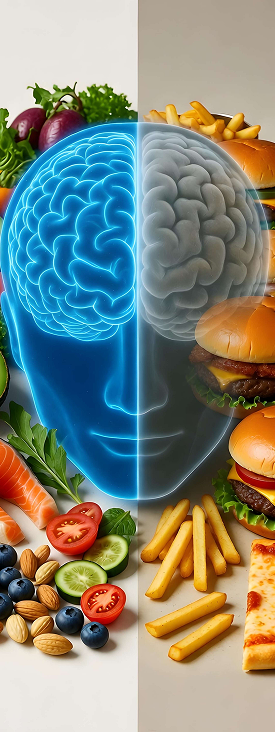
Both situations are inflammatory and disrupt normal development, microglial activity, and synaptic pruning during development, altering neural plasticity. On the other hand, diets rich in saturated fats and ultra-processed foods, which usually promote weight gain and even obesity, also have a pronounced inflammatory effect. Thus, inadequate diets are all inducers of inflammation and disruption of neural development.

If some of these nutritional conditions become chronic during early childhood, brain development can be compromised, with consequences for cognitive development and school learning.

Nenhuma tag encontrada.

Impact on Childhood and Adolescence

Under certain conditions, this is aggravated by alcohol consumption by pregnant and breastfeeding women. Alcohol also induces neuroinflammation and delays in the development of adequate neural circuits, with a significant impact on early childhood and adolescence.

Diets rich in omega-3 fatty acids and the consumption of quality proteins are costly for families, who then opt for foods high in saturated fats and fried foods (which appease hunger) or ultra-processed foods (which cost less). If some of these nutritional conditions become chronic during early childhood, brain development can be compromised, with consequences for cognitive development and school learning.

It is important to emphasize that these conditions can be aggravated in low-income populations but can also affect children of all social classes with poor nutritional habits. For this reason, it is important to highlight the role of the school and public policies such as the National School Feeding Program (PNAE), which establishes the inclusion of food and nutrition education in the school and preschool pedagogical projects.

If some of these nutritional conditions become chronic during early childhood, brain development can be compromised, with consequences for cognitive development and school learning.

Read +